Arabian monarchies
Dynasties and ruling structures in the Arab world
The monarchical systems of the Arab world cannot be explained by the classical feudal model of Europe.. While in Europe, the historical nobility mostly emerged from a class defined by land ownership, feudalism, and military obligations, the monarchies of the Middle East and the Arabian Peninsula rest on entirely different foundations. They are based on powerful ruling families, deeply rooted tribal associations, religious legitimacy, and modern state administrative structures.. Terms such as king, emir, sultan or sheikh each describe entirely different political, historical and social roles within the region.. Instead of a rigid, hereditary aristocratic system in the European sense, familial and dynastic affiliation shapes all political events here, with the ruling families traditionally acting as the highest tribal and state leaders.
1. Saudi Arabia: The Center of the Absolute Monarchy
The Kingdom of Saudi Arabia is governed as an absolute monarchy by the Al Saud dynasty, which has been significantly shaping the country and its predecessor territories for more than 250 years.. The history of the Al-Saud family is inextricably linked to the spread of Wahhabism and the unification of the Bedouin tribes in the Arabian Peninsula. The Saudi Arabian King serves as the undisputed head of state and at the same time as the supreme authority in all political, economic, and military matters.. Unlike in European parliamentary systems, there is no written constitution in the classical sense; instead, the Quran forms the fundamental legal basis of the state. The royal family bases its power on a complex and historically evolved alliance with influential tribal leaders, religious scholars, and the indigenous population.. Tribal leaders and Bedouin associations traditionally play an important role in local governance and in maintaining internal stability.. Thanks to its gigantic oil and natural gas reserves, Saudi Arabia has developed into a global economic power in the 20th and 21st centuries., The distribution of offices and economic resources within the vast Al-Saud family is closely linked to the political survival of the regime. Although nobility in the European sense has no place here, the concept of royal lineage and belonging to the ruling family has an absolute political relevance that has no traditional limits. Title of nobility far exceeding in importance.
2. Kuwait: The Emirate with a parliamentary tradition
Kuwait is a historically developed emirate on the coast of the Persian Gulf, which has been ruled by the Al-Sabah dynasty since the early 18th century.. The Al-Sabah line has led the country through numerous historical challenges – from British protectorate to the Iraqi invasion at the beginning of the 1990s – and has developed it into a significant regional trade and financial hub.. The political architecture of Kuwait differs in some essential respects from the absolute monarchy of Saudi Arabia. At the top is the Emir as head of state of the royal family, who has the final say in all crucial matters of the state.. Below the Emir, various princes and members of the Al-Sabah family hold important ministerial positions and key administrative positions in the government.. At the same time, however, Kuwait possesses a comparatively vibrant parliamentary tradition with an elected National Assembly that exercises constitutionally-established control and speaking rights. The position of the ruling family and the influential Kuwaiti families is deeply intertwined with the country’s religious and economic identity.. While oil wealth ensures the state's prosperity, the balance between the dominant Al-Sabah dynasty and the elected representatives of the people remains the defining characteristic of the Kuwaiti monarchy.
3. Bahrain: The constitutional island kingdom
Bahrain is an archipelago of islands in the Persian Gulf that has a long and fascinating history as a trading and transit point between Mesopotamia, India, and the Arabian Peninsula. The country is ruled by the Al Chalifa dynasty, which took control of the islands in the late 18th century. For a long time as an emirate, Bahrain officially became a constitutional monarchy under King Hamad bin Isa Al Chalifa in 2002. This constitutional reform was a significant step that was intended to advance the modernization of the state and enable stronger political participation. The king continues to hold extensive executive powers as head of state and commander-in-chief of the armed forces, including the right to appoint the prime minister and the cabinet. In addition to the royal family, a bicameral parliament – with an elected Chamber of Deputies and an appointed advisory council – shapes the country’s political life. Bahrain’s political and social structure is strongly characterized by the historical duality between the ruling Sunni dynasty and the majority Shiite population, which has repeatedly led to internal political tensions in the past. Nevertheless, the monarchy remains the stabilizing pillar of the island state. Economically, compared to some of its neighbors, Bahrain quickly adapted early on to diversify the revenues from oil extraction through the development of a strong financial sector, tourism, and the aluminum industry. A historical Title of nobility In the European sense, there is no such thing in Bahrain, but the Al-Chalifa family forms a closed, highly respected leadership stratum whose members hold all the strategic positions in government, the military, and the state economy and have been steering the fate of the country for generations.
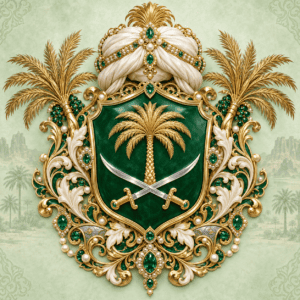
Emir of Nadschd
64,90 €
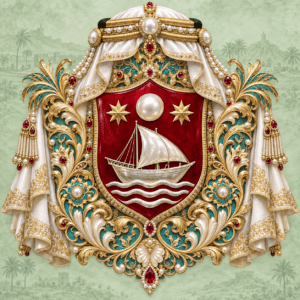
Sheikh of Schardscha
89,90 €

Sharif of Mekka
34,90 €
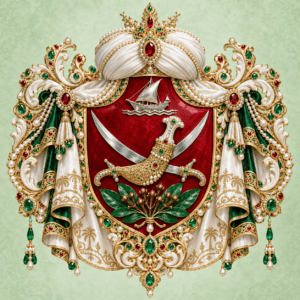
Sayyid of Sansibar
59,90 €
4. Qatar: The emerging emirate of the Al-Thani dynasty
Qatar plays an independent and economically extremely influential role on the peninsula in the Persian Gulf. The country has been ruled by the Al-Thani dynasty since the 19th century, which has successfully steered the country from a collection of poor fishing and pearl diving settlements to one of the richest countries in the world per capita. Political power in Qatar is highly centralized and concentrated in the Emir, who acts as the absolute head of state and commander-in-chief. Under the leadership of the Al-Thani family, Qatar has undergone a remarkable transformation in recent decades, which is based on the gigantic reserves of natural gas – especially North Field, one of the world’s largest gas fields. Internally, the ruling system is characterized by a close patriarchal and tribal-based bond between the ruling family and the Qatari citizens, who benefit from a far-reaching system of state welfare benefits. Although the permanent constitution of 2004 provided for elections for an advisory council (Madschura al-Schura), the executive and legislative final decision is traditionally made by the Emir and his closest family members. In foreign policy, Qatar has chosen a strategy of active diplomacy, mediation in international conflicts, and massive global investments to secure its sovereignty in a neighborhood dominated by larger regional powers. The Al-Thani family controls the central levers of power, and membership in this ruling clan replaces any form of traditional aristocratic hierarchy by guaranteeing absolute political and economic exclusivity.
5. Oman: The traditional Sultanate on the Wafra Street
The Sultanate of Oman in the southeast of the Arabian Peninsula boasts a millennia-old history as a seafaring trading nation that once controlled an empire from East Africa to Belutschistan. The country is ruled by the Al-Said dynasty, which came to power in the 18th century and has continuously shaped Oman ever since. Unlike many other states in the region, the title of ruler in Oman is fundamentally different: At the head of the state stands the Sultan, who unites both secular and historical religious authority. Over the decades, modern Oman has been shaped by the visionary and stability-oriented rule of Sultan Qabus bin Said, who led the country out of isolation in 1970 and built a modern infrastructure, education, and healthcare system with the revenues from moderate oil wealth. After his death in 2020, his cousin Haitham bin Tariq assumed the regency, which continues seamlessly the course of political stability, economic diversification („Vision 2040“) and the traditionally neutral foreign policy. The political system of Oman is an absolute sultanate, but it relies heavily on consensus-building within the traditional tribal society, local advisory assemblies (Madschis al-Schura), and a deeply rooted Ibadi Islamic tradition known for its tolerance. The Al-Said family forms the country’s political elite, but in comparison to other Gulf monarchies, they remain discreetly in the background in their representation. A classic Title of nobility is not provided for in Omani law; instead, social status is based on tribal loyalty, achievements for the state, and close ties to the ruling Sultan.
6. United Arab Emirates (UAE): Federation of Ruling Families
The United Arab Emirates (UAE) is a unique federal state on the southeastern coast of the Arabian Peninsula, founded in 1971 as a merger of seven originally autonomous sheikhdoms. These emirates include Abu Dhabi (the political and territorial center), Dubai (the economic and tourist heart), Sharjah, Ras al-Chaima, Adschman, Umm al-Qaiwain, and Fujairah. Each of these emirates is governed by its own hereditary ruling family, which historically has come from the influential tribes of the region – such as the Al Nahyan in Abu Dhabi or the Al Maktoum in Dubai. The constitution of the UAE provides for a federal structure: the President of the UAE is traditionally elected from the ranks of the sheikhs of Abu Dhabi, while the Prime Minister and Vice President are appointed by the ruler of Dubai. This division of labor has proven extremely stable and economically extremely successful. The UAE have transformed themselves in record time from a collection of coastal sheikhdoms into a modern, globally interconnected knowledge and financial economy that relies heavily on artificial intelligence, aviation, trade, and renewable energy. Power in the individual emirates rests firmly in the hands of the respective ruling families, whose sheikhs rule as absolute local monarchs, while the federation is held together by the Supreme Council of the rulers. In this federal monarchy, the ruling families form the undisputed upper class, with familial networks and tribal descent determining the social pyramid.
7. Jordan: The Hashemite Kingdom
The Hashemite Kingdom of Jordan occupies a geographically and historically unique position among the Arab monarchies. It is located in the heart of the Middle East and is ruled by the Hashemite dynasty, which is one of the most prestigious and historically significant families in the Islamic world. The Hashemites trace their lineage directly from Hashim, the great-grandfather of the Prophet Muhammad, and were for centuries the traditional guardians of the holy sites in Mecca and Medina before assuming control of newly created Transjordan after the First World War. King Abdullah II, who has been on the throne since 1999, leads the country as a constitutional monarchy in which the monarch has extensive executive and military powers. Jordan differs from the wealthy Gulf monarchies in that it has no significant deposits of natural resources or oil, and instead faces major economic challenges, water shortages, and the enormous humanitarian burdens caused by millions of refugees from neighboring countries (Palestine, Syria, Iraq). The political system is based on a historical partnership between the royal family, loyal eastern Jordanite tribes, and the large Palestinian-speaking population. Despite numerous regional crises and wars, the Hashemite monarchy has proven remarkably stable. The royal family enjoys high prestige in the country due to its religious legitimacy and its role as a guarantor of national security. A Western Title of nobility It does not exist in Jordan, but the lineage of the Prophet and the affiliation with the Hashemite House confer upon the members of the royal family an unparalleled moral and political authority that permeates the entire fabric of the state.
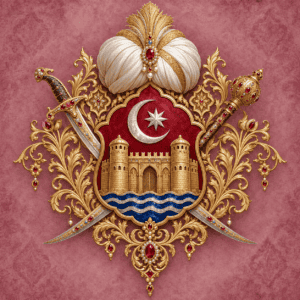
Pasha of Baghdad
59,90 €
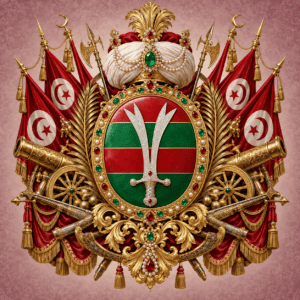
Bey of Tunis
74,90 €
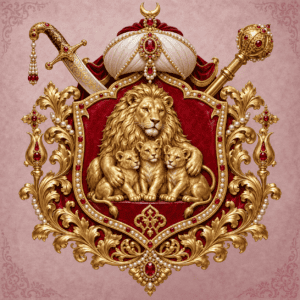
Effendi of Janina
129,90 €
Agha of Saloniki
34,90 €