German nobility titles
Add a distinctive touch of class and durability to your name: A German aristonym combines the rich cultural history of the empire with a sovereign style and a lived-in understatement in the present.
Count & Countess | Duke & Duchess | Prince & Princess | Baron & Baroness
A timeless statement
German nobility traces its roots to a tradition spanning more than a thousand years, which has shaped the heart of Europe like no other. From fortified castle seats to magnificent residences, counts, princes, earls and lords embodied a sense of responsibility, attitude and cultural excellence. Today, this historical fascination can be rediscovered in a completely personal way: as a resounding, style-defining adjective for your everyday life.
With us, you are not purchasing any arbitrary artistic terms; instead, you are acquiring historically verified German noble titles from extinct dynasties. Each individual title is fully verifiable and can be transparently searched on renowned heraldic portals as well as in historical archives and lexicons such as Wikipedia.
We associate selected titles with contemporary projects such as territorial patronage or symbolic co-ownership, for example in Irish lands or sustainable plantations in Africa. In addition, we present a small, clearly labeled selection of curated creations, such as the House of Katharienburg, which is harmoniously inspired by historical models to create particularly beautiful coats of arms and resonant naming traditions.
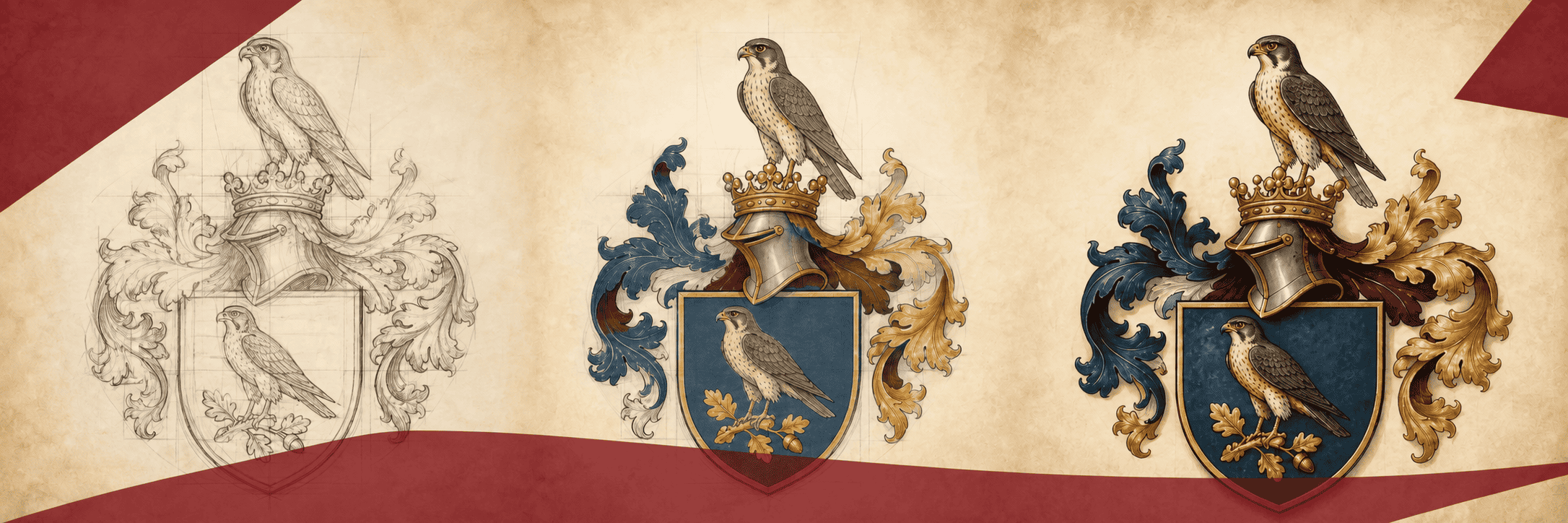
With every appointment, you receive a masterfully designed, historically inspired family coat of arms that faithfully reproduces the house’s traditional symbolism – perfect as wall decoration, for seal rings, or fine stationery.
In addition, every title purchased includes the comprehensive book „My Title of Nobility“. This reference work delves into the fascinating history of nobility, explains the system of coat of arms, and shows you practically how to style your new title in social and business settings. Secure a tangible piece of German noble history and give your name a distinctive note of class and durability.
Overview of German noble titles
The German noble lineage of the Holy Roman Empire created a multifaceted structure of ranks that continues to set standards in terms of attitude and style to this day. Our range includes the most important historical ranks with their respective titles: Duke, Prince, Count, and Baron or Baroness. From the autonomous tribal duke to the universal territorial prince, through the resilient territorial count and the traditional free lords, these ranks cover the entire spectrum. Each title represents a distinct historical heritage, a deep-rooted presence in historically significant regions, and that timeless dignity that gives your appearance as an aristocrat an unmistakable note.

The ranking of German nobility
In the German nobility, the Duke, as the supreme Reichsfürst, formed the top of the hierarchy beneath the royal crown, followed by the Prince, who ruled as the lord of the realm over territories that were not subject to the control of the king. The count was entrusted with the independent administration of vast principalities and strategically important border regions. The unwavering foundation of the nobility was formed by the Freiherr and Baron, whose holders enjoyed immediate imperial privileges. This clear hierarchy still reflects a closed chain of growing authority and responsibility.
In the overview:
| Emperor | Duke | Baron / Baroness |
| King | Prince | Knight / Noble / Lord |
| Grand Duke | Count / Margrave | |
| Kurfürst | Count |
Count & Countess
The Count has a long tradition of history as a royal official and territorial lord. From the Burgrave to the Reichsgrafen, these personalities ruled entire provinces, protected vital trade routes, and promoted the culture of their residences. A Count title combines down-to-earth stability with noble sovereignty and a pronounced sense of enduring values.

Duke & Duchess
As the commander of the ancient Germanic tribal nations and the most powerful prince of the empire, the duke combined military prowess with a commanding presence. The tribal duchies laid the foundation for European imperial history. To this day, the duchy stands for supreme leadership authority, monumental foresight, and an aura of majestic, historically grown greatness.

Princes & Princesses
The concept of a prince originates from the Old High German word for the first. As a ruler in the council of the imperial princes, he conducted diplomacy, science, and architecture on the European stage. The title of prince exudes cosmopolitan elegance, independent creative ability, and the aspiration to leave a mark on one’s own era as a pioneer.

Baron and Herr
As a free man on his own land, the Baron, referred to in international parlance as a Baron, enjoyed immediate imperial privileges outside the constraints of rigid court regulations. Whether a proud knightly landowner or a valued advisor to the Crown: The Baron embodies to this day that straightforward steadfastness, native roots and discreet nobility that make up true class.
What you can do with an noble title
A historical Aristonym gives your own appearance a distinctive, traditionally-oriented touch and naturally transforms classic forms into the present. Since it is a legally acceptable name form, you are entirely free to use it in your private and social life.
A stylish accent in social life: Use your title and the prestigious reputation in personal correspondence, on beautifully designed invitation cards, when booking exclusive hotels or for high-end table reservations. It gives the name a classic, cultured form that remains discreetly remembered.
A representative eye-catcher for the office or law firm: The expertly crafted appointment certificate and the ornate historical coat of arms create a noble visual effect in the matching wooden or gold frame. Whether on the wall above the desk, in the law firm library or in a high-quality document folder: The document adds a distinguished accent of elegant quality.
Personal heraldry and fine letter-writing: The accompanying coat of arms can be used in a versatile and individual way. As a fine monogram, it adorns heavy hand-drawn cardboard, adorns personal business cards, serves as a vector template for engraving an elegant seal ring or functions as an exlibris stamp in one's own book collection.
Informative conversation material with historical context: The Aristonym is not just an empty artistic term; it bridges the gap to a bygone dynasty that has now disappeared. Upon requests from friends, guests, or business partners, you can refer them to the detailed chronicle and the activities of the historical house.
A distinction of lasting value: Such a rank is ideally suited as a symbolic gift for significant milestones in life, such as round birthdays, anniversaries, or retirements into retirement. It is a lasting tribute to personalities who possess a sense of history, class, and established values.
You are not acquiring an abstract exhibition piece, but an independent, contemporary name form. A title from the Noble Society Institute combines the cultural heritage of past eras with a sovereign, well-mannered lifestyle in the here and now.
Since when has there been nobility in Germany?
The roots of German nobility reach deep into the early Middle Ages. After the collapse of the Roman Empire, the great Germanic tribal confederations of Saxony, Franconia, Bavaria, Swabia, and Thuringia formed in the transition from the Late Antiquity. At the forefront were proven clan leaders and military commanders who stood out for their military success, sound legal judgment, and extensive land holdings.
Under the Carolingians and Ottonians, this original nobility consolidated into a permanent alliance of fiefs and kingdoms. From the former leaders emerged the powerful tribal princes who, together with the emperors, ruled the Holy Roman Empire. Over the centuries, this incomparably dense, decentralized network of noble dynasties was formed, building castles, founding cities, and shaping the German cultural and educational landscape into the modern era.
Large houses and historic lines
The traces of the ancient ruling families still mark Germany to this day. Famous imperial dynasties such as the Staufer left a lasting monument to knightly power with monumental castles like Trifels or Hagenau and their world-famous rulers.
In addition, there still exist ancient dynasties that have ruled entire regions over many centuries and whose family branches are deeply rooted down to the present day: the House of Wittelsbach, whose history is inextricably linked to Bavarian lifestyle, art promotion and world-renowned castles; the House of Hohenzollern, whose influence extends from the Frankish castle to the classical-style residences of Prussia; the traditional House of the Welfs, one of the oldest still-existing noble families in Europe with its seat in Lower Saxony; and the House of Wettin, which, as Electorates and Kings, founded the rich Saxon cultural and residential landscape. This lineage demonstrates that the heritage of nobility in Germany is not a forgotten relic but a vibrant, highly esteemed cultural foundation.