
Nobility titles in ID cards
Registration in identity documents is a fascinating milestone, but by no means a requirement: Your Aristonym will unfold its fascination and social impact from day one – regardless of any official stamps.
Mythology, truth and the official path
Three persistent misconceptions surround the nobility title on a passport: Many believe that one can simply march to the town hall with a purchased document and have the civil surname officially changed to „Graf“ or „Herzog“. Others are convinced that the registration of such a title in official documents is fundamentally illegal or prohibited. And anyone who has heard of the path leading from the artist name often mistakenly assumes that one must be a nationally famous actor, musician, or prominent television personality to do so.
Time for a factual overview: What actually applies legally – and how the process for obtaining the official document works.
Personal development: Everyone is allowed to call themselves whatever they want
The desire to have a soundly named presence in everyday life and in social life is deeply rooted in the desire for individuality. In Germany, this is legally supported by Article 2, paragraph 1 of the Basic Law (GG), This protects the free development of personality. As long as no rights of third parties are violated and no laws are broken, it is in principle permissible for anyone to call themselves in private and social contexts in a way that corresponds to their own style.
Why the civil name remains unchanged
The situation is different with the family name registered in the civil registry. According to German law (regulated in the Civil Code, BGB), a name once acquired is generally immutable. Any change to the official surname is subject to extremely strict conditions and, as a rule, is only possible through marriage, adoption, or in the presence of very special, serious exceptions (such as when the name is offensive or ridiculous). Therefore, any arbitrary change of the official birth name for the purpose of title management is not provided for in this way.
The elegant way: The noble title as a name in the passport
However, there is a practical and proven way to anchor the acquired noble title in your official documents: the use of the artist name.
According to the legal provisions of the Personal Identity Card Act (PAuswG), it is possible to have a fictitious artist name entered into the designated field of the personal identity card and passport. Since a historically-based pseudonym, as defined by legal precedent, can be used in public appearances as an artistic or distinctive name, this approach serves as a bridge between historical heritage and modern identity documentation.
This is how you get to the entry
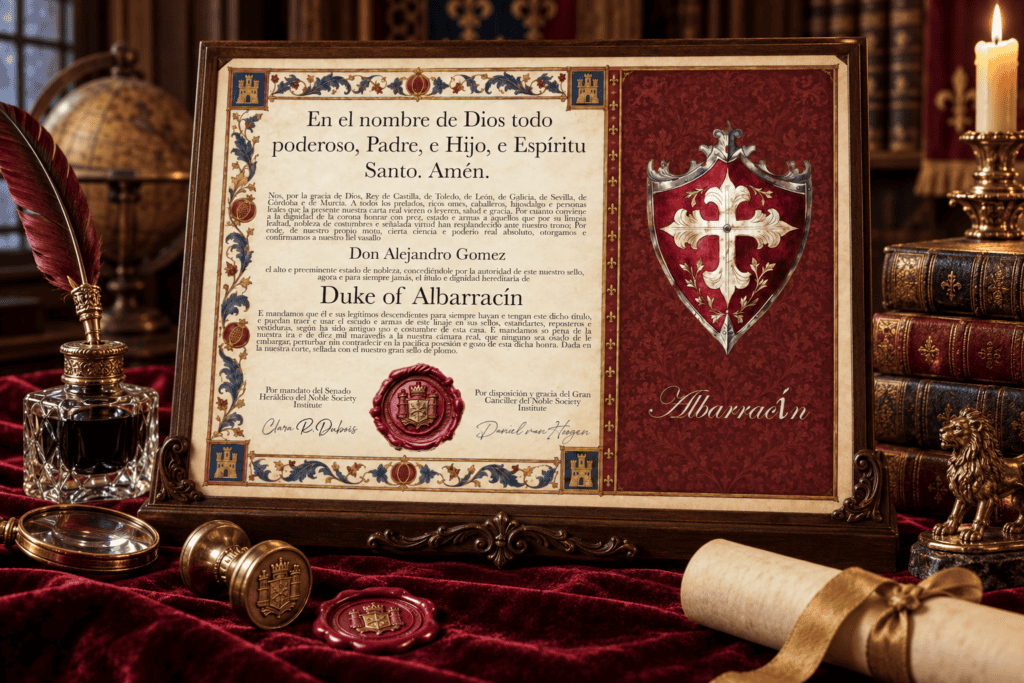
1. Choose the foundation: You acquire a historical noble title with us, the Noble Society Institute, including the coat of arms and the accompanying reference book.
2. Establish the name: Use your Aristonym in your business or social life – whether through publicistic activities, business correspondence, business cards, authorship or cultural engagement.
3. Collecting evidence: Document your public appearance under the new name (this serves the municipality as proof that the name is actually used in real life).
4. Application to the registration authority: With these proofs, you submit the informal application for the artist’s name to be entered in your personal ID card or passport at your competent civil registry office or municipal registration office. As soon as the authority approves it, your Aristonym will officially appear on the back of your ID card.
Filling the Aristonomy with life: ways to achieve real external impact
For the civil registry office, what counts is not a short-term alibi campaign but verifiable evidence that you are creatively or publicly active under that name in real life. It is about genuine, lasting use – not just the occasional uploading of arbitrary files, merely to be able to present a document quickly. Anyone who links the title to their own interests, talents, or professional interests creates, in a completely natural way, exactly those traces in everyday life that a registration authority would like to examine.

Books and publications of your own in self-publishing
One of the strongest and most easily accessible media is the written word. Thanks to modern self-publishing platforms like Amazon KDP (Kindle Direct Publishing) allows anyone today to bring a real book to the market without a publisher, without fixed printing costs, and without technical knowledge. To do this, simply write a manuscript in Word or Pages, export the text as a PDF, and upload it along with a cover to the platform. As the author name, you enter your Aristonym.
The work automatically receives an official ISBN number, is listed in worldwide bookshops, and is only printed when a reader orders it.
The possibilities for content are endless: you can create a photo book about your last holiday trip, publish a lovingly designed family cookbook with traditional recipes, write bedtime stories for children, or write a practical guide on your favorite topic, whether it be classic car restoration, gardening, or personal experiences from your field. Later, simply present the printed pocketbook with your name on the cover and on the book’s spine to the account manager, supplemented by the official link to the shop presence.
Your own website, thematic blog or audio formats
Having a dedicated digital home underscores the fact that you are permanently putting your content out there. With building-kit systems like WordPress, Squarespace, or Wix, it’s possible to set up an appealing website in no time. Thematically, everything you’re passionate about is suitable—from historical perspectives to art history and architecture to reviews of wines, cigars, or upscale men’s and women’s fashion. If you prefer speaking rather than writing, you can publish a thematic podcast on free platforms that is automatically available on providers like Spotify or Apple Podcasts.
The decisive proof for the municipal registry lies in the legal notice of these websites: If you are listed there as the editor, owner, or author of your Aristonym, and you have been maintaining the page with content for months, this proves a continuous and serious presence in the public eye.
Guest contributions, specialist articles and reviews in external media
You do not necessarily have to create your own platforms; working on existing media also counts as publishing. Write in-depth reader letters, professional articles for industry magazines, or guest commentaries on thematically relevant online portals. Detailed book, theater, or art reviews in cultural forums are also excellent examples, provided they are published under your chosen artist name. Proof of publication to the authorities includes copies of printed magazines, newspaper clippings, or direct archive links with a visible author line.
Art, Photography and Design Portfolios
The right to display your work includes creative activities of all kinds. Whether you paint in your free time, take photos with a high level of artistic quality, make wooden objects or design jewelry, you are making these works visible to third parties. Set up a small gallery website where you present your works, or offer individual works, prints or unique items on platforms like Etsy or eBay under an artist profile with your name. Participation in a local art exhibition, an arts and crafts market or a vernissage in your region can also be documented through flyers, exhibition catalogs and press reports.
Volunteering, club life and social engagement
A title can also be firmly established beyond the digital world. Immerse yourself in the social life of your home region by using your Aristonym. This can be achieved, for example, by taking on the role of patron for heritage protection projects, cultural initiatives, or charity events. Similarly, involvement in the board of a local heritage, history, or support association is also suitable. If you are mentioned by name in club records, program booklets, publications, or reports in the local press, this forms one of the strongest and most prestigious forms of social recognition.
An indispensable reference for government practice
As tangible as these procedures may be, a realistic expectation is just as important. A published book or own website does not automatically guarantee success at the municipal office. The registration authority always decides on a case-by-case basis according to its own discretion. How strictly the external impact criterion is interpreted varies depending on the federal state and the relevant officer. Even with a large number of supporting documents, there is no legally enforceable right to have the entry recorded in the document.
The best approach remains therefore to choose a project that will bring you personal pleasure anyway. If the book, photography, or volunteer work itself is fulfilling, there is never the impression of a duty—and you will, incidentally, receive the most authentic basis for argument that one can present to an authority.

The registration of an artist's name after Section 5, paragraph 2, no. 12 of the PAuswG It is within the lawful discretion of the competent reporting authority. First and foremost, the officers assess whether there is a risk of confusion and whether the pseudonym is actually used in everyday life. If an authority hesitates or rejects the application, this almost always stems from insufficient substantiation.
Remain calm and request a written explanation. Often, simply deepening the evidence file is sufficient: provide additional evidence such as published articles, invoices for Aristonym, the imprint of your website, business correspondence, or evidence of voluntary engagement.
In addition, you have the regular legal recourse of contesting a formal rejection notice. Many registration authorities are cooperative as soon as it becomes clear that this is not a whim but a seriously and publicly conducted pseudonym with a verifiable historical foundation.
Yes. The same rule applies analogously to the German passport (Section 4, paragraph 1, sentence 2, no. 4 of the PassG) An artist name recognized by the civil registry can be entered both on the back of the identity card and on page 2 of the passport.
However, when traveling internationally or applying for visas, the official birth and family name always serves as the primary basis for identification.
Yes, that is perfectly legal under German civil law. According to Section 12 of the German Civil Code A registered artist name also enjoys comprehensive protection of the name. What matters is whether it has established itself in the public eye as a designation („traffic name“).
You may enter into everyday legal transactions, rental agreements, reservations, and private agreements under your artist name, as long as there is no intent to mislead about the actual identity. In the case of notarial documents or official tax returns, only the civil name is added to unambiguously identify the person.
Banks and credit institutions are bound by the Money Laundering Act (GwG) and must keep the account internally under the civil name of the citizen. However, most private banks and credit card providers easily allow the artist name entered in the passport to be printed as an additional address or directly as a name on the credit card. A non-formal proof of the passport entry is usually sufficient for this purpose.
No. The passport and identity card law does not link the registration to a main professional artistic activity or membership in the Artists' Social Fund (KSK). The determining factor for the registration authority is solely the proof that the name is being used seriously in social, cultural, journalistic or economic life under a pseudonym with some degree of public impact.
Sovereignty does not need an official stamp
Why the passport entry is purely optional
A widespread misconception is that the effect or legitimacy of an noble title only begins with its entry in official documents. The opposite is true: A historical aristocratic title exerts its fascination and benefits completely regardless of whether it appears on the back of your identity card.
Registering as an artist name is a purely voluntary option – a nice additional milestone for anyone who enjoys official documents, but by no means a prerequisite. Under German law, you are fully free to use your title in everyday life, in social interactions, or in business contexts, without any problems or restrictions within the framework of your general personal rights.
Whether on hand-drawn letterhead, personal business cards, during high-end table reservations, hotel bookings, or as a decorative eye-catcher with coats of arms on the wall of your office: The Aristonym exudes personality through its personal attitude, the understated style it embodies, and its storied history.
True nobility is defined by sovereign demeanor and refined style – not by a stamp of authority.