Paths to the title of nobility
Acquiring noble titles: The three ways compared in practice
Anyone who wants to buy an aristocratic title encounters three fundamentally different models. A compact overview of the costs, legal requirements, and everyday usability:
1 Adult adoption: The bureaucratic special procedure
The path through the family court: A bearer of an aristocratic name adopts you as an adult.
The flip side: Extremely expensive (often five to six figures), months-long court proceedings and strict scrutiny of a genuine parent-child relationship. Completely disproportionate to the mere desire for a representative appearance.
2 Lord & Lady with a connection to the land: From the Highlands to the Far East
The Anglo-Saxon principle: rank and land ownership form a unity. They are appointed Lord or Lady through real or symbolic land ownership.
The appeal: Authentic roots in Scotland (Laird) and Ireland (Tiarna) or patronages over cultural lands in the Seychelles and Kenya. A resounding title with high conversational value and a real environmental focus.
3 Historical noble titles: Free guidance with history and coats of arms
The most flexible and popular way: you build on real, documented dynasties from Germany, Europe and beyond.
Full freedom: As a free Aristonym that is legally secure and free of bureaucracy in everyday use – on business cards, letterheads, when making reservations, or as an artist name. Complete with a certificate of nobility, full coat of arms, and a historical house chronicle.
Buying noble titles through adult adoption: Legal foundations and reality
When the term "acquired noble titles" is mentioned in a passport, it almost always refers to a so-called Full-age adoption (adult adoption) This is the basis for the current situation. Since the Weimar Reich Constitution came into effect in 1919, the privileges of nobility have been abolished; former titles such as „Graf“, „Freiherr“ or „Prinz“ are purely legally considered to be independent parts of the bourgeois family name. For adults without an existing familial connection to a noble bearer of a name, adoption is the only way to acquire such a name as a primary family name.
The legal procedure under § 1767 BGB
Adoption in adulthood first requires a notarized application from both parties to the competent family court. After Section 1767, paragraph 1 of the Civil Code (BGB) However, an adult may only be accepted as a child if the acceptance morally justified It is provided for by the legislature primarily when a genuine, mature parent-child relationship has already developed between the recipient and the one receiving the support.
Family courts examine this requirement very carefully during an in-depth personal hearing. If the court is under the impression that purely financial considerations, a name purchase, or the mere acquisition of a prestigious name are the primary factors at play, the legally required moral justification is lacking. In such cases, the adoption application is regularly rejected by the courts.
Costs, duration and legal obligations
Anyone considering adoption must be prepared to face significant financial and personal hurdles. Commercial adoption agencies often charge fees in the five to six-digit range for the initial contact – without any guarantee of how the relevant court will ultimately decide. In addition, there are notary and court fees, as well as procedural delays that can last for many months or even years.
Furthermore, a positive court decision establishes a genuine legal relationship of kinship with reciprocal rights and obligations. This can in individual cases entail far-reaching probate consequences as well as potential family law claims for maintenance and care, which go far beyond the original interest in a well-sounding name.
And what about getting married early?
The traditional route involves marrying a person with an aristocratic surname in order to choose that surname as a civil marriage name. However, as a targeted strategy for acquiring titles, this route is hardly realistic in everyday life: A marriage entails profound personal and financial obligations – from the legal status of property to separation periods, to issues of divorce and alimony. For those who want to use an aristocratic title simply and confidently for their social appearance without having to alter their private life circumstances, they choose the Direct acquisition of an Aristony the immediate, independent solution.
Conclusion: The smart, contemporary way to obtain your own noble title
Adoption and marriage are lengthy bureaucratic processes for those who must change their official family name – always associated with serious obligations and high costs.
The sovereign advantage of our title: With a historical aristocratic title or land title, you enjoy full freedom in social and business life – from business cards to elegant stationery, and from reservations and contracts. Moreover, your new title is fully printableAccording to the provisions of the Passport and Identity Card Act, you can completely legally use your noble title in everyday life if you make appropriate use of it. Have artist or religious name officially entered in your identity card and passport.
You thus receive the best of both worlds: a historically significant, representative name with full social prestige and official registration possibility – immediately available, at a fraction of the cost and guaranteed without cumbersome bureaucratic or court procedures.
Lord & Lady with Landholdings: How Territory, Tradition, and Title Merge
The concept of having a title like Lord or Lady Conducting land acquisition is based on one of the oldest legal traditions of the Anglo-Saxon world. While noble titles on the European mainland were predominantly granted as so-called personal nobility – the title thus attached itself purely to the name or to the family –, over many centuries the principle of Territorial nobilityWhoever owned a certain piece of land, naturally acquired the right to be called by that title.
Today, this tradition is undergoing a modern and cosmopolitan renaissance. By legally acquiring a share of the property, you are directly linked to this historical tradition and are fully entitled to carry the territorial title associated with it in a completely legitimate and proud manner in everyday social life.
Scotland: The traditional custom law of the Lairds
In Scotland, the term Laird deeply rooted in centuries-old customary law. Originally originating from Scotland, the word simply refers to a landowner or manor owner. In English usage, this status has always been synonymous with Lord Translated, while the feminine form is traditionally Lady reads.
Historically, a Laird was not necessarily part of the hereditary nobility of the House of Lords; rather, as a landowner he enjoyed high status, influence, and the protection of his territory. Since the right to hold the title is inextricably linked to ownership of Scottish land, this status passes to the acquirer. Thus, a purely civil name is completely legitimised into a proper title such as the Laird of Glencairn or Lord of Glencairn – a historically significant addition that ensures genuine recognition value on business cards, letterheads and in everyday correspondence.
Ireland: From the Celtic Tiarna to the Lord of Kerry
In Ireland, the history goes even further back – to the age of the ancient Gaelic clans. In the ancient Irish legal system, the head of a territory or dominion was called the High King. Tiarna, which in Gaelic literally means „the lord“ or „the master“. When the Anglo-Norman feudal system took hold, these Gaelic chieftain traditions merged with the English term "lord". Lord.
Anyone who today acquires land ownership in one of the legendary Irish counties – such as the picturesque County Kerry – becomes part of this Celtic heritage. Lord or Lady of Kerry They carry a name that reflects the green expanses, the untamed character and the myths of the island. They combine historical dignity with a distinctive Irish way of life.
Overseas projects: Patronage with a sense of purpose in the Seychelles and in Kenya
We have taken this Anglo-Saxon principle from the European mainland and developed it further: Instead of simply empty land, you acquire sponsorship rights over vibrant, valuable cultural and useful plant landscapes with us. Seychelles You will become part of tropical cultural land in the Indian Ocean and combine your title with the protection of paradisiacal nature and traditional plantations.
In Kenya Build on the world-famous history of highland coffee. As a patron, you support the preservation of traditional growing areas and the preservation of centuries-old coffee cultures. This commitment becomes even more tangible in Kenyan Community GardensHere, your appointment as Lord or Lady directly connects with a tangible social and ecological benefit for the people living in the area who manage these gardens in a communal way.
How does the title manifest itself in everyday life?
The title harmoniously combines your surname with the respective region. You receive official appointment documents, detailed maps of your country, and a masterfully designed coat of arms with regional symbols. Typical and particularly resonant forms include:
- ✦ Max Mustermann, Lord of Kerry (or Erika Mustermann, Lady of Kerry)
- ✦ Laird of Glencairn / Lady of Glencairn
- ✦ Lord Max of Mount Kenya / Lady Erika of Seychelles
A title with genuine territorial relevance that perfectly combines universal elegance, lively conversational value and meaningful environmental protection in everyday life.
Historical noble titles: Free guidance with history and coats of arms
The sovereign and contemporary path leads through Real historical titles of nobility. Our archive draws from a worldwide collection of prestigious houses and powerful dynasties that extends far beyond the borders of Central Europe.
The spectrum includes venerable German principalities, noble titles and European princes and duchies with deep imperial history, as well as the prestigious high nobility of the Mediterranean from Italy, Spain or France. This panorama is complemented by fascinating houses from the colonial empires of the Americas and the Far East, as well as traditional ruling dynasties from Asia and the Orient.
You acquire them no arbitrary fancy terms, Rather, they build directly on the inherited legacy of historically established lineages. Each of these houses is a preserved part of history and can be transparently researched and understood on Wikipedia, in scholarly works on nobility, and in classic heraldic publications.
The Aristonomy: Full freedom without bureaucratic red tape
Such a historical title is used in modern everyday life as a so-called Aristonym – completely independent of any official allocation, club statutes or statutory requirements.
They enjoy the unrestricted freedom to use their new name and the corresponding coat of arms in their private, social, and business environments at their discretion. As they move within this framework of free personal development, this occurs without legal risks or cumbersome bureaucratic proceduresYou acquire the title once only, permanently and without any ongoing obligations.
Sovereign presence in everyday social life
Even in practical application, there are no limits to your creativity. A historical Aristonym gives business cards, letterheads and personal signatures a unique character. distinctive note and sets a clear sign of style awareness with invitations featuring hand-crafted wooden badges or elegant stationery.
For reservations in Grand Hotels and upscale gastronomy The soundful title ensures a special experience and perfect service. Similarly, the coat of arms can be classically engraved into a gold or silver seal ring – a timeless piece of jewelry with character that often remains in the family for generations.
Furthermore, many title holders are establishing their Aristonym with great success in public: whether as a noble author name for publications, on podcasts, in art or in creative projects. They authentically continue the history of the house in the 21st century and create A centuries-old cultural treasure is once again visible.
Representative total inventory for each title
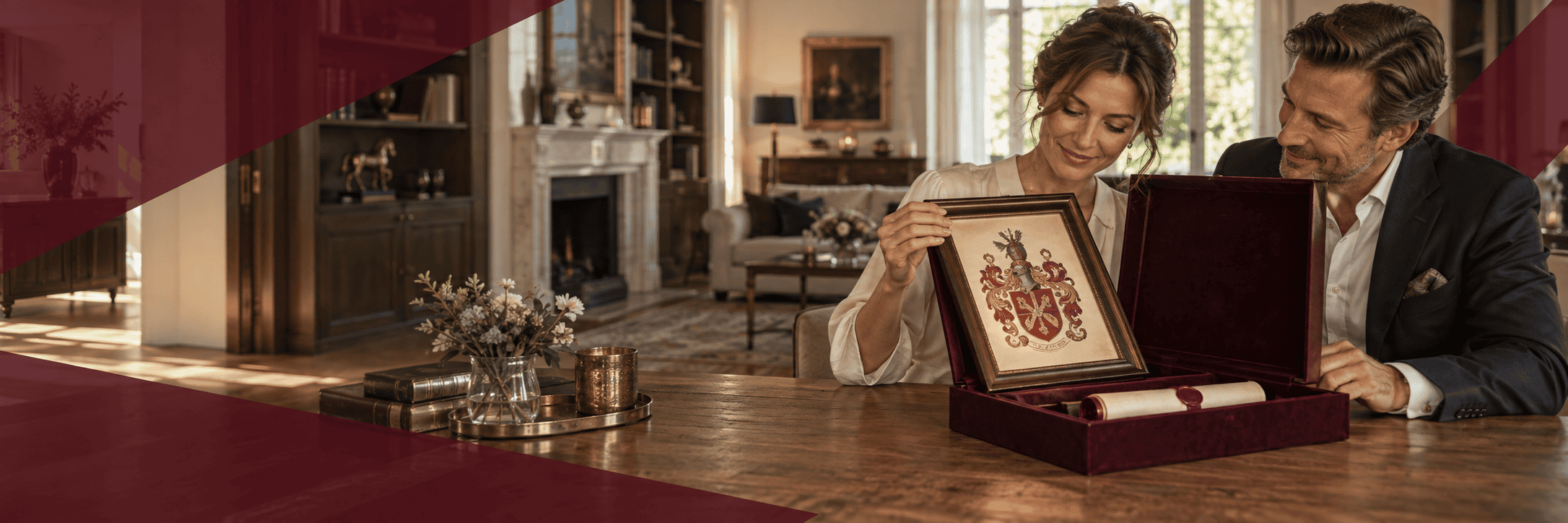
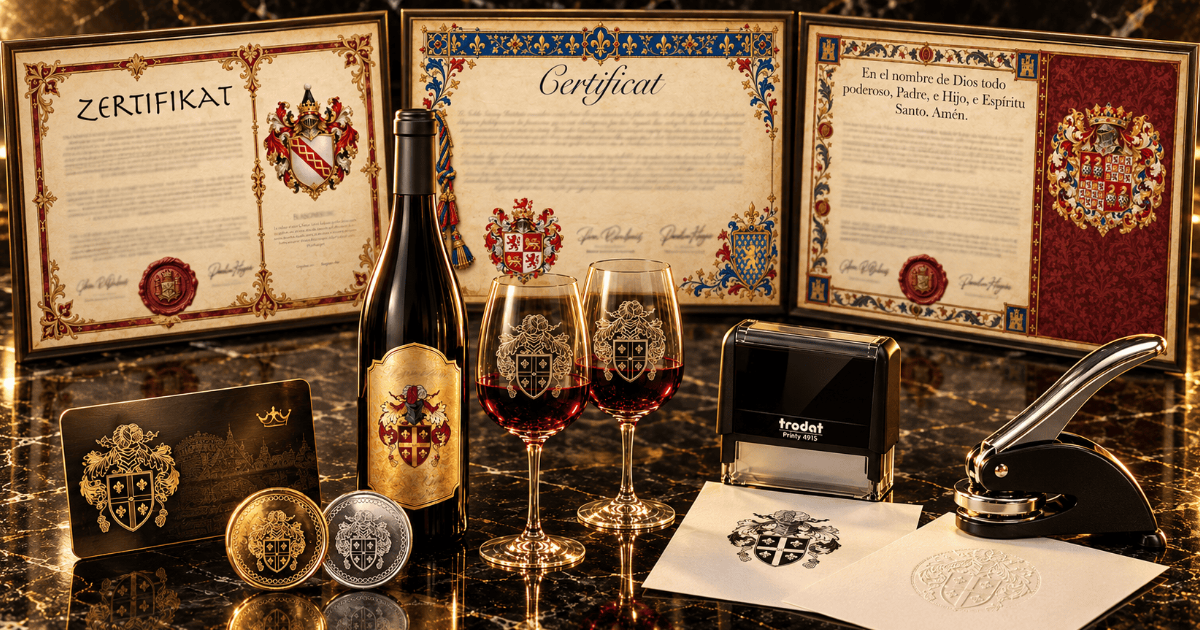
- ✦ Beautiful jewelry certificate: A elaborately crafted noble letter on finest paper, solemnly and representatively documenting your appointment and your connection to the respective house – perfect for a stylish framing.
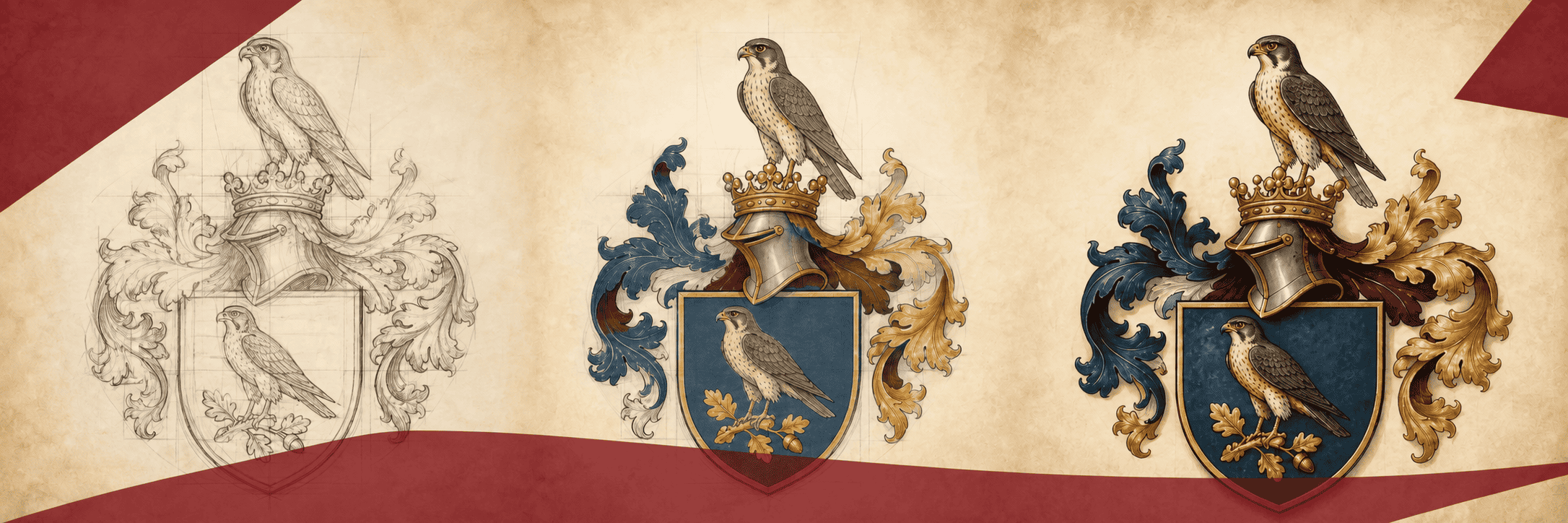
- ✦ Heraldically-based full coat: The ancestral coat of arms of the family, masterfully reconstructed and digitally provided in the highest resolution for engravings, foil prints, seals and fine embellishments.
- ✦ Historical house chronicle: A thorough documentation of the historical origins, the most important personalities and the heraldic significance of the dynasty.
Sources and legal basis
Germany
In Germany, historical titles of nobility are considered part of the family name; new titles of nobility may not be granted. Furthermore, the free development of personality is subject to the limits set by the Basic Law.
- Article 109, paragraph 3 of the Weimar Constitution – Titles of nobility
- Article 2, Paragraph 1 of the Basic Law – free development of personality
- Section 1767 of the German Civil Code – Requirements for full-fledged adoption
- Section 1768 BGB – Application and family court ruling
- Section 1757 of the German Civil Code – The effect of the adoption on the name of the adoptive parent
- BGH, Decision of 14.11.2018 – XII ZB 292/15
United Kingdom and Scotland
The British authorities distinguish between recognized titles of nobility, Scottish lairds, manorial titles, and merely purchased or stylized titles. The use and registration are governed by the respective type of title and the supporting documentation provided.
Ireland and property ownership
Property and other land rights are documented in Ireland through the competent state registration office. The specific legal effect of a land purchase is determined by the respective contract and register documents.