Nobility in Central and Eastern Europe: Poland, the Czech Republic, Hungary and Russia
Introduction: Diverse political spaces and different aristocratic cultures
The region of Central and Eastern Europe, in contrast to the highly centralized Western monarchies, did not have a uniform order of nobility.. The historical regions of Bohemia, Poland, Hungary and Russia each developed completely independent legal forms, council assemblies, social traditions and title structures.. Determined by alternating shifts of borders, the rise and fall of great empires such as the Habsburg Monarchy, the Russian Empire and Prussia, and by profound political upheavals, these noble orders were repeatedly transformed over the centuries.. Each of these countries brought forth a distinct characteristic of aristocratic culture that is deeply rooted in national history..
1. Poland: The noble republic of the Szlachta
The Polish nobility, known as the Szlachta, took an absolutely unique position in Europe. Originally formed as a purely warrior caste, the szlachta grew over the centuries into an unusually large and politically extremely powerful class compared to the overall population, which at times accounted for around ten percent of the population.. This situation created the so-called "Republic of the Nobility" in Europe (Rzeczpospolita), in which the nobility enjoyed extensive political and legal rights. Until the early 16th century, Polish nobility traditionally did not bear fixed family names; they merely added the name of their estate or residence to the baptismal name with the prefix „z“ (corresponding to the German „von“).. Later on, the custom evolved to convert these designations of origin into personal names with the characteristic endings „-ski“, „-cki“ or „-icz“, often supplemented by affiliation to a specific heraldic community.. After the Polish partitions in the late 18th century, a large part of the untitled nobility lost their rights, as the origin could not be proven for a price, while the upper nobility confirmed its privileges from the partition powers.. After the historical upheavals of the 20th century, today's Polish nobility continues to maintain its traditions as an established social and historically aware community..
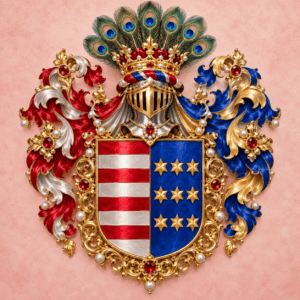
Prince of Sandomir
89,90 €
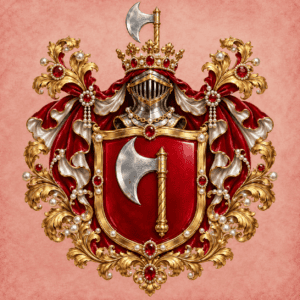
Count of Tęczyn
119,90 €
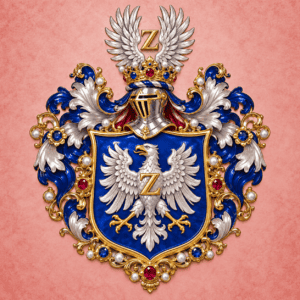
Nobleman of Zator
124,90 €
2. Czech Republic: Bohemia, Moravia and the Permanent Order
The Bohemian and Moravian nobility was closely intertwined with the countries of the Habsburg Monarchy over the centuries.. Traditionally, in the Kingdom of Bohemia, a strict distinction was made between the old feudal class, the noble class, and the knightly land nobility.. By 1500, just about thirty powerful families controlled the Bohemian Parliament, possessed a privileged judicial jurisdiction, and benefited from personal tax exemption.. The peasant uprising of 1618 and the subsequent purges led, under King Ferdinand II, to the radical disempowerment of the Protestant nobility.. Numerous nobles were dispossessed and migrated, while the followers of the Counter-Reformation and new Catholic families took over their lands.. The renewed Land Ordinance of 1627 sealed the absolutism of the Habsburgs, with the conferment of titles and the inkolat henceforth subject to the direct decision of the king.. After the founding of Czechoslovakia in 1918, the nobility was abolished, titles were legally prohibited, and far-reaching land reforms were carried out.. After the Velvet Revolution of 1989, some families received back parts of their historic castles and properties under restitution laws..
3. Hungary: The broad Hungarian needle and the magnates
In Hungary, the situation was as autonomous as in Poland, since a classic Western European feudal system in its pure form did not exist there.. Historically, the nobility originally consisted of all members of the fighting Magyars who were not subject to any other ruler and followed the king's banners; this formed a broad group of nobles, which accounted for about fifteen percent of the population.. From this position, the powerful magnate families rose to prominence over time.. From the 15th century onwards, the lower nobility and the representatives of the cities formed the nobility table, while the higher nobility and the high prelates formed the magnate table.. Among the traditional privileges of Hungarian nobility were exemption from customs duties, taxes and requisitions, as well as the right for a nobleman to be judged solely by his peers.. The Hungarian nobility always considered itself the leading elite of an independent nation, even though it was linked to Austria and Bohemia through the Danube Monarchy for centuries.. After the First World War and the Treaty of Trianon, Hungary remained a kingdom without a king under Reichsprotector Miklós Horthy, before the communist regime carried out the expropriation and persecution of the nobility after 1945..
4. Russia: The Dvorjanstwo and Peters ranking list
In Russia, the nobility bore the title Courtly life and presented a multifaceted mix of ancient princely lineages – such as the descendants of Rurik and Gediminas – as well as the service class characterized by state duties. In the early Middle Ages, the Bojaren shaped the political landscape; their titles were not hereditary at first and were not tied to fixed landholdings.. Tsar Peter the Great carried out a fundamental reform by issuing the rank table on January 24, 1722, which divided state service into fixed classes and linked promotion to personal or hereditary nobility with administrative and military careers.. In addition, Peter I introduced the European standards of count and baron in Russia.. In the 18th century, the privileges of the aristocracy were massively expanded; under Empress Catherine the Great, the nobility received the unrestricted right to dispose of the serfs under their control in 1785, a right that had persisted until the reforms of Tsar Alexander II.. The October Revolution of 1917 destroyed these structures violently, but the historical legacy and genealogical associations survived into the present day.. Even if today is a historical day Title of nobility In these states, where their legal role no longer plays a role, the multifaceted history of the nobility in Central and Eastern Europe remains a central component of cultural memory..

Count of Ostermann
24,90 €
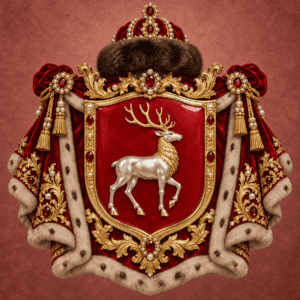
Boyar of Rostow
44,90 €
Baron of Poscharski
129,90 €