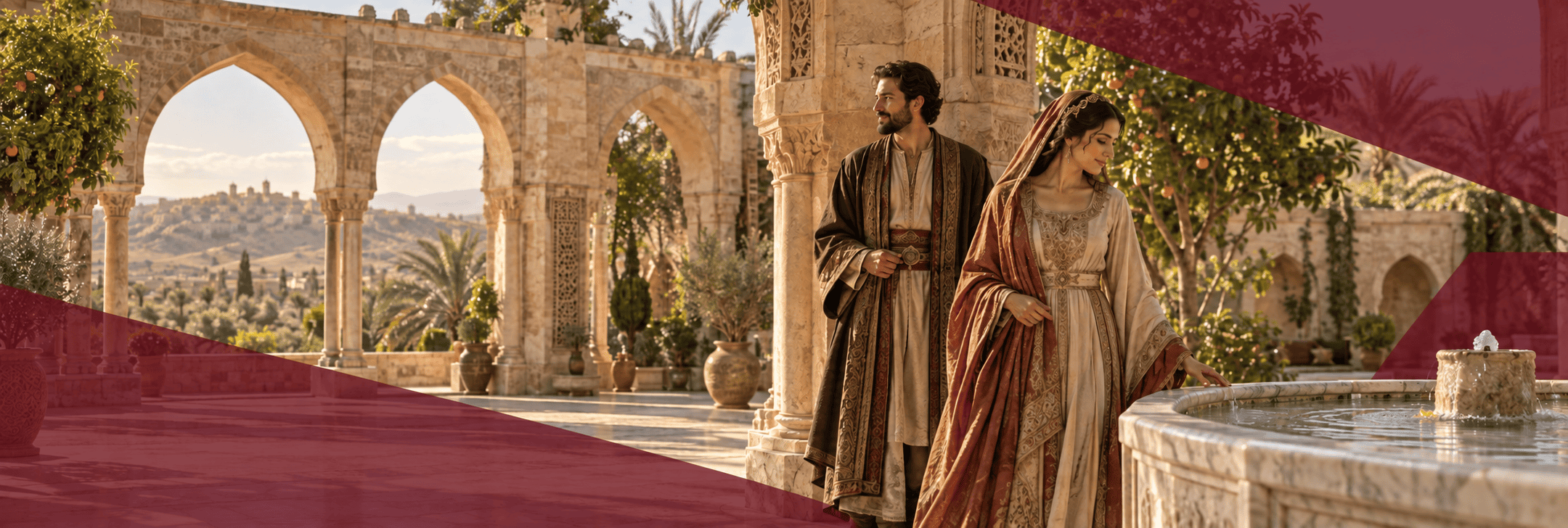

In the Ottoman Empire, the princely power of a Pasha was measured not by glittering crowns but by dried horsehair. The very symbol of status was the so-called Tugh – an elaborately carved wooden stick on which the tails of noble stallions or mules swam. The higher the Pascha climbed in the military hierarchy, the more rose tails he carried with him during field campaigns and parades: A simple governor was allowed to adorn himself with only one tail, an experienced army commander carried two tails, and the mighty grand vizier rode with proud three rose tails at the head of the army. Only the Sultan himself could top this bizarre spectacle and claimed up to six tails for his entourage. When an Ottoman army advanced, enemy scouts panicked at the waving horse hair on the horizon, calculating in a flash how many cannon shots and elite Janitscharen would be fired back at them.
The title of the Ottoman Grand Vizier, the Sadrazam, Sounding like absolute sovereign glory, in everyday life, however, the most dangerous top job in world history was the one held by the Grand Vizier. As a guardian of seals and the right hand of the Sultan, the Grand Vizier controlled vast provinces, possessed immense wealth, and resided in the famous High Gate. However, if he lost a battle, the state coffers went into deficit, or simply incurred the wrath of the harem, the ruler did not hesitate for long with court proceedings. The chief palace gardener, who Bostancıbaşı, The , who also served as the executioner of the court, discreetly knocked on the minister’s door and solemnly presented him with a silk cord. According to ancient custom, a grand vizier absolutely must not be beheaded like a common criminal, since noble blood should not stain the ground. The powerful dignitary had no other choice but to kiss the cord reverently and be helplessly strangled in his own study – which is why some clever statesman would panicingly reject the coveted title in order to keep his head on his shoulders instead.
Although the Eastern empires were considered purely male domains externally, in reality it was women who ruled the Ottoman Empire in the 16th and 17th centuries – an era that historians aptly called the “Era of the Women.” Women's dominance (The Reign of Women) were baptized. At the top of the ranking stood the Valide Sultan, The Queen Mother, flanked by the Haseki Sultan, The imperial chief consort. Legendary rulers such as Kösem Sultan or Hürrem Sultan (known in the West as Roxelane) drew all the political strings from deep within the Topkapı Palace, formed alliances with European kings and dismissed viziers and sultans at will. Since Ottoman law forbade women from holding the official throne, the powerful ladies simply received foreign ambassadors behind thick-walled gates or had orders conveyed to the Council of State via trusted palace eunuchs. Those who wanted to secure a ministerial post, landholdings or fleets in Constantinople did not bribe the ruler on the gold throne; instead, they sent precious silk and jewels into the chambers of the Valide Sultan.
In the Persian Empire, rulers claimed a title since ancient times that was hardly to be surpassed in terms of self-confidence: Schahanschah, Which literally means „King of Kings“. A Persian Shah did not see himself as a simple prince, but as the living center of the entire universe, to whom all other monarchs of the world were unconditionally to bow down. The culmination of this imperial splendor was in the 18th century with the construction of the legendary Peacock Throne, which was covered with thousands of rubies, emeralds, sapphires and pure gold and featured a gemstone-encrusted peacock with a sparkling feather skirt at its peak. When the Shah held his audiences, the subjects and foreign envoys had to wear Proskynese perform – lie flat on your stomach and touch the dusty carpet with your forehead, without looking directly at the ruler. When Western diplomats in the 19th century insisted on standing upright in front of the Persian throne, the court ceremonial master simply had the doors of the reception halls installed so extremely low that even the proudest ambassadors had to bend low to crawl into the hall at all.
In the glitzy realms of the Indo-Oriental Mughal rulers and princely states, the Nawabs and Nizam the concept of luxury in frightening dimensions. The most famous of them was the Nizam of Hyderabad, who ruled over a vast, semi-autonomous principality and, at the beginning of the 20th century, was considered the richest man on the planet. His princely wealth was so immense that he simply used the famous Jacob Diamond – one of the largest gemstones on Earth worth several million – as a mere wastepaper shredder on his desk so that the rising breeze would not confuse his bills. While European princes struggled to collect taxes, the Oriental Nawabs owned their own pearling fleets, kept hundreds of armored war elephants with gilded tusks and let tons of fragrant rose water be sprayed over the heads of their guests at festivals. Anyone who held themselves in some way as a Nawab did not travel in ordinary carriages, but had themselves carried through the crowd in velvet-clad carriages by dozens of servants, while groomsmen and fliers ensured that the noble personage did not suffer the slightest inconvenience.