
Golden times: When privilege determined fate
Anyone who today thinks of the historical nobility often has visions of glittering balls, sparkling chandeliers and elegant carriages. But behind this glamorous facade lay a harsh system that divided society into two seemingly irreconcilable halves over the centuries. On one side stood the overwhelming majority of the population, who worked the fields, paid taxes and possessed few rights. On the other side sat a vanishingly small elite, for whom life was an endless series of exclusive special privileges.
The word “privilege” derives from the Latin for an exception to the rule, and that is exactly what it meant in the truest sense of the word. Those born into an aristocratic family entered the world on a red carpet that almost cleared every stumbling block from their path. One did not have to laboriously work out one’s social status, pass exams, or conduct negotiations. The mere cradle in which one was born determined power, wealth, and status.
These privileges were by no means merely folkloric side-effects; they formed the legal and economic foundation of entire states. A nobleman not only possessed land, but often determined the entire fate of the people who lived on it. He collected tithes and taxes, while himself being spared most of the burdens of the community. The rules that applied to ordinary citizens were carved in stone at the gates of the castle park.
It was a world of absolute self-evidentness, where inequality was celebrated not as a scandal but as a given order from God. From today’s perspective, this rigid structure seems almost absurd, yet it shaped the image of what prestige and social greatness meant over generations. To understand why Title of nobility it still possesses such a fascinating aura today, it is worth taking a closer look at how this power manifested itself in everyday life at that time.
Hunting, Taxes and One's Own Judge: The Three Pillars of Power
When looking at everyday life in the Middle Ages and the Early Modern Period, the noble privileges relied primarily on three unwavering pillars that were simply denied to the rest of the population. The first and most visible in the landscape was the exclusive hunting right. Forests, meadows, and rivers were considered the private playground of the castle owner. While a farmer whose harvest was trampled by hungry wild boar was not even allowed to aim a slingshot at the animals, the noble society rode through the fields in colorful costumes with hunting dogs. Anyone who, as a simple citizen, even caught a single rabbit to feed their starving children, ended up on the gallows or in the deepest dungeon as a hunter.
The second pillar was a dream that modern citizens could only dream of: the far-reaching freedom from taxes. According to the logic of the time, the nobility did not pay its dues in humble gold, but with their own blood on the battlefield. Even when the knights’ era had long since passed and mercenary armies waged the wars, the princes and barons simply kept this tax exemption. The simple people bore the entire burden of the state, financing magnificent roads, fortifications, and bridges, while the lords resided in their castles without having to pay a single penny to the general tax coffers.
The third and perhaps most frightening pillar concerned jurisdiction. Should a nobleman actually find himself in conflict with the law, he need not fear being dragged before the same judge as the cobbler or the miller. The nobility was subject to so-called patrimonial jurisdiction or its own court of justice. This simply meant that one was judged exclusively by members of the same class, who naturally had a very pronounced understanding of the transgressions of their own caste. Moreover, the lord himself often served as the highest judge over his subjects on his own lands, making justice a rather one-sided affair.
These three pillars provided the upper class with a power that today seems unimaginable. They demonstrated daily who held the strings and who had to bend to the will of those in power. It was an era in which justice did not protect against arbitrary rule, but rather inequality, on the contrary, was cemented with legal acrimony.
Ceremonial and pomp: The fine privileges in the court
In addition to the tangible legal and financial power, there was an at least as strict world of subtle symbols of status. At the princely court, no step, no glance, and no breath was left to chance. Who was allowed to stand where, how deeply one had to bow before whom, and who was the first to pass the bowl at the table were governed by meticulous ceremonial books. This courtly protocol acted like an invisible ranking system that showed every present person, to the second, where their place in the universe was.
This separation was particularly drastic in the so-called dress codes. Today, everyone wears what they like and what their wallet allows. In the past, however, real trouble threatened if a wealthy merchant came up with the idea of dressing in velvet, ermine fur or expensive silk. Such precious fabrics were by law reserved exclusively for the upper class. Even certain colors, such as the noble purple, or wearing gold jewelry were strictly regulated. The message was clear: No one should adorn themselves with foreign feathers or even give the impression, visually, of belonging to the chosen elite.
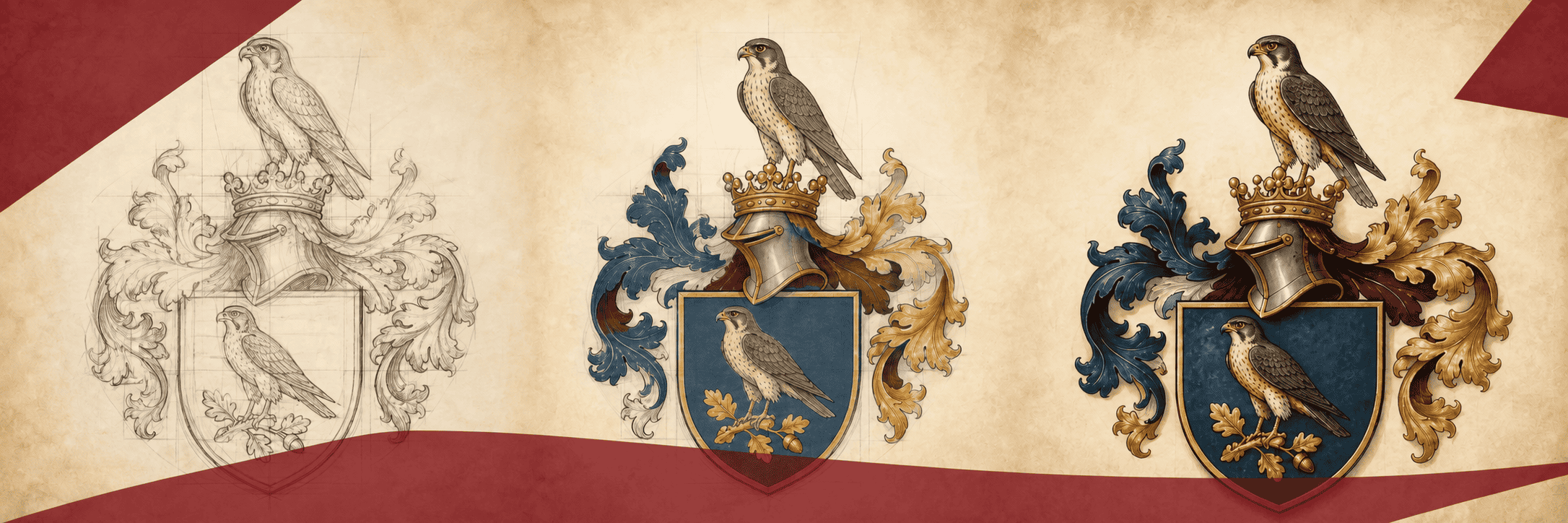
In public life too, the nobility insisted on its dominant position. In festive processions, in church or later in the opera, the front rows, the most luxurious boxes and the most comfortable velvet seats were naturally reserved for the counts and barons. A simple citizen had to stand aside, put on his hat and lower his head when a stately carriage thundered over the cobblestones. Even in death, the distinction continued: private chapel choirs and richly decorated family crests ensured that even after one’s last breath one did not have to spend eternity alongside the ordinary people.
These fine privileges created an aura of unattainableness. They transformed the nobles into figures that almost floated above earthly things. They acted as if on a theater stage, and the audience was expected to marvel and politely clap their hands in appreciation.
The bitter end: When the special rights lapsed
As unshakable as this magnificent fortress of prestige and splendor seemed to have been over the centuries, it eventually collapsed in its own strength. When the last German Emperor abdicated after the tremors of the First World War in November 1918, the foundation of the old order had already become fragile. The final legal conclusion was finally reached by the Weimar Constitution in August 1919 with its famous Article 109. With a single sentence, the newly elected legislature swept away all public-law privileges of birth without a trace.
From today to tomorrow, the three pillars of aristocratic dominance dissolved into thin air. The hunt for deer and wild boar was henceforth bound by ordinary lease agreements and clear laws, rather than being an exclusive birthright of the castle lord. The tax offices no longer returned visits to the royal gates, but demanded taxes and duties like any other citizen. And anyone who came into conflict with the law now found himself before completely ordinary state judges, completely indifferent to how many archbishops roamed the hall of fame.
The polite protocol also disappeared from the official offices. The authorities were instructed to no longer make deferential bows and to refrain from using submissive titles such as “His Majesty” or “His Excellency” in official correspondence. For many members of the old upper class, this change felt like a severe setback. They suddenly had to learn to press the same button on forms as the baker or the postman.
But the Republic did not deny people their identity. It removed the legal distinctions, but kept the evocative designations as a simple part of the bourgeois surname. Power was forever broken, the privilege of birth was history. But what surprisingly survived was the fascination with the extraordinary, which in the following decades would develop in a completely new direction.
The modern upgrade: attention, charm and the little red carpet
Anyone who today believes that with the end of the old laws the appeal of a noble title has also disappeared is greatly underestimating human psychology. People love stories, glamour and the extraordinary. Although in the twenty-first century there are no tax exemptions and no more subjects, there is a completely new, immensely pleasant privilege that one can now use quite casually: the pure, unadulterated attention in everyday life.
Everyone is familiar with the phenomenon of many encounters fading into the monotony of the ordinary in a hectic, digitised world. But as soon as a resonant name comes into play, the atmosphere changes noticeably. Anyone who reserves a table with the name Graf or Baron in a first-class restaurant almost always notices a noticeably attentive smile at the greeting. The sommelier inevitably takes a moment longer to recommend the appropriate drink, and in the hotel, with a little luck, an ordinary standard room becomes, quite casually, a suite with a view of the park.
This is not at all due to a lack of foreignness, but simply to the joy of playing with style and elegance. People appreciate a charming demeanor, and a well-sounding title acts as an elegant icebreaker. At private invitations, at business receptions, or on elegant paper, it immediately creates conversation, arouses curiosity, and elevates its wearer from the crowd in a refreshingly unobtrusive way.
Modern privileges are no longer hard legal privileges, but soft social advantages. It is the privilege to be remembered, to stand out positively, and to bring a piece of historical grandeur into everyday life for oneself and one’s fellow citizens. No one has to perform any official duties anymore, but a smile and a touch of red carpet are almost guaranteed everywhere.
Noblesse as a way of life: the most beautiful privilege of our time
When one looks at the historical development from medieval feudalism to the present day, a remarkable transformation becomes evident. In the past, a Title of nobility rigid compulsory corset, accompanied by harsh political power, strict social isolation, and often great responsibility towards the dynasty and court, was imposed upon individuals. One was born into a fate that left hardly any room for personal freedom.
Today, however, the true nobility is completely free from these constraints. No one has to fight battles anymore, manage feudal properties, or justify themselves before the authorities. What remains is the essence of the whole: a commitment to elegance, good taste, and sovereign composure. Those who choose a resounding title today are not choosing a means of power, but a stylish personal upgrade for their own sense of life.
Perhaps the greatest privilege of modernity lies precisely in carrying these traditions with ease, humor, and confidence. It is about making an impact in everyday life, delighting ourselves and others, and looking at the world with a charming smile. True privileges no longer come from birth certificates or parliamentary resolutions; they come from the way we present ourselves, the way we approach people, and the amount of attitude we demonstrate.
History has torn down old barriers to create space for individual grandeur. The brilliance of bygone eras has by no means faded – it is now open to anyone who is willing to celebrate the extraordinary and enrich their own lives with a noble nuance.