The Cradle of the Early Middle Ages: Of Knights, Swords and Kingly Loyalty
Anyone who wants to uncover the roots of nobility must look far back in time to a time when the mighty Roman Empire was crumbling and Europe resembled a patchwork of wandering peoples, impassable wildernesses, and uncertain borders. In this harsh early Middle Ages, what counted was not a melodious pedigree or a magnificent castle Coat of arms. What counted was simple, raw combat power paired with unwavering loyalty to a leader.
The Germanic kings and tribal leaders faced the formidable task of defending vast tracts of land against marauding neighbors. No ruler could accomplish this alone, which is why the monarchs surrounded themselves with a group of particularly reliable and brave warriors. These followers pledged allegiance to their lives and deaths and formed the military backbone of the empire. From these mounted warriors, who rose above the broad masses of ordinary peasants through their skill with weapons and courage, grew the very first nucleus of what would later be known as the nobility, which would govern the destinies of the continent.
Over time, the purely warrior camaraderie transformed into a permanent social institution. Those who proved their mettle in battle were not only rewarded with loot and pats on the shoulder by the king; they were also given responsible tasks in the country. The most loyal warriors were entrusted with the oversight of border markers, river crossings, and fortified farmsteads. They became administrators and guardians in an era where law and order existed only where a sharp sword was nearby.
Thus, the pragmatic necessities of a warlike era laid the foundation for an entirely new elite. The nobility was not conceived in glittering ballrooms, but emerged on muddy paths. It was a caste that had to first fight for its privileged status with tangible effort before, generations later, it began to chisel its power into stone and parchment for eternity.
Land versus loyalty: The ingenious wheelwork of the Lehnswesens
With the onset of the High Middle Ages, the rulers faced a gigantic logistical problem. The empire of Charlemagne and his successors extended over thousands of kilometers, yet there were neither fortified roads nor modern bureaucracies, let alone quick money to support a standing army or paid officials. Anyone who wanted to rule as king had to find a way to secure his land from afar and keep his followers firmly in line permanently. The answer to this dilemma was feudalism, a system of astonishing simplicity and tremendous effectiveness.
The king granted vast tracts of land, along with the farmers who lived on them, to his closest confidants. This land, the so-called fief, remained formally the property of the Crown, but the fiefholder was allowed to keep the revenues, taxes, and dues for himself. In exchange, the nobleman swore eternal allegiance to his monarch and committed himself to immediately appear on the battlefield with an agreed-upon number of armed knights in the event of war. From this practice emerged the classical offices and titles: a count, derived from the Latin term for companions, managed a fixed-sized county, while a margrave secured the particularly vulnerable borderlands of the empire militarily.
To further distribute the burdens, the counts resorted to the same trick downward. They handed over parts of their territories as fiefs to smaller followers and barons, who in turn equipped simple knights. A hierarchical pyramid emerged that held together all of medieval Europe. Whoever sat on a piece of land enjoyed protection from above and owed service upward, while he commanded and spoke with authority over the people among them.
The decisive historical turning point occurred when these fiefs became irretrievably hereditary over the generations. What was originally intended as a purely service obligation for life transformed into permanent family ownership. The administrators became the absolute lords of their territories. The nobility broke free from the mere dependence on the king and created stable dynasties whose names were now firmly associated with mountains, valleys, castles, and rivers.
Honor Code and Tournament Chant: When the Warrior Became a Knight
With the firmly established system of feudalism, the nature of the fighters themselves also changed. From the rough, purpose-equipped warriors of the Early Middle Ages, a glorious caste with its own self-understanding emerged in the High Middle Ages: the Knights. Complete armor, a battle horse capable of fighting, and the necessary entourage had become impossibly expensive, so only wealthy landowners and their sons could perform the service on horseback. The military service became finally an exclusive privilege of the nobility.
However, iron and muscles soon weren’t enough to belong to this community. Under the influence of the church and courtly poets, a strict ideological framework emerged that was intended to be cultivated from simple models of appearance. True knights were expected to possess bravery and loyalty, but also moderation, generosity, the protection of the weak and widows, and the famous chivalric manners towards women. The minnesang began to appear in the castles, and the social scene became almost as important as the battlefield.
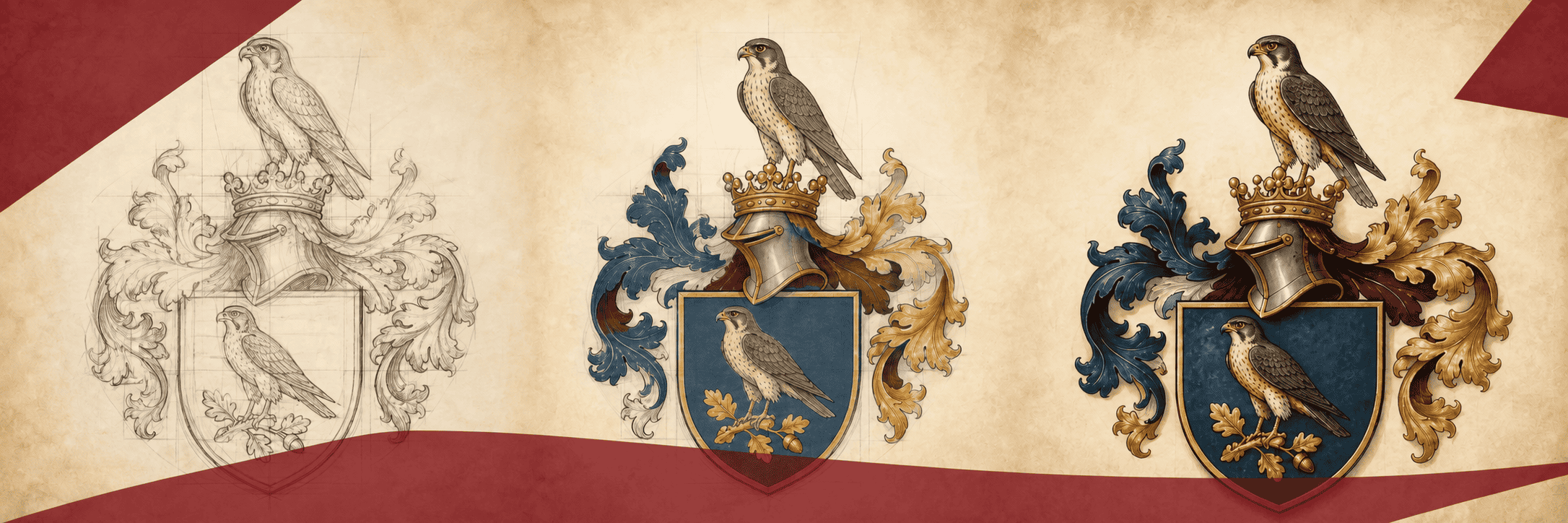
At the magnificent tournaments held throughout the empire, the elite gathered to showcase their fighting prowess and splendor. Since the warriors had become completely unrecognizable through their closed helmets and heavy iron plates, a practical solution was needed to identify them. Thus, artistic Coat of arms and decorative helmet designs were born. From colorful stripes, lions, eagles, and crosses on the shields evolved the sophisticated science of heraldry, which continues to fascinate to this day.
This Coat of arms became the eternal face of the entire family, painted on shields, carved into castle gates and imprinted on wax seals. Those who Coat of arms led and received the knightly honor belonged to a brotherhood that honored the same ideals across linguistic and national boundaries. The nobility had created a fascinating mythology that combined elegance with martial determination and echoes in countless legends to this day.
Silk instead of iron: When the kings lured the nobility to the court
With the advent of gunpowder, cannons, and disciplined foot troops, the iron armor of the knight in the battlefields of the Renaissance gradually lost its military value. A well-placed lead ball meant little to the proud Coat of arms and chivalrous virtues. At the same time, the monarchs, who wanted to centralize their realms and increasingly considered the idiosyncratic, defensive land nobility in its fortified castles as an annoying security risk.
The response of the kings in the Age of Baroque and Absolutism was as sophisticated as it was spectacular. Instead of fighting the nobility with military force, they built them golden cages. Palaces like Versailles in France or the countless princely residences in the Holy Roman Empire became enormous magnets for the aristocracy. Those who wanted to gain influence, favor, and lucrative positions no longer had to nestle in their native provinces but had to be present at the royal court.
There, the former warlord transformed himself into an elegant courtier. Instead of fighting in the mud with his sword, they now engaged in duels with polished tongues, perfected etiquette, and exquisite fashion. The kings invented a sophisticated ritual in which seemingly mundane actions—such as stretching the royal collar when getting up—were elevated to coveted status symbols. Those who were allowed close proximity to the monarch determined the events, while the others clamored for attention and spent astronomical sums on silk wraps, wigs, and carriages.
In this way, the Crown subdued the powerful caste and molded it into a representative elite that was to carry the glory of the state outward. Although the nobility gave up its military independence, it gained a maximum of world-class refinement, artistic taste, and Baroque festive culture, which has significantly shaped the image of aristocratic luxury to this day.
Factories, the Nobility and the Revolution: The Break with the Old World
With the advent of the nineteenth century, the feudal structure came to its final collapse due to the force of the industrial revolution and the rise of a self-conscious bourgeoisie. Merchants, bankers, factory owners, and inventors built vast fortunes that effortlessly overshadowed the wealth of some indebted castle lords. The king suddenly needed money for modern railway networks and chimneys, and the bourgeoisie demanded in return social recognition on equal terms.
Thus, the phenomenon of the noble class saw its greatest flowering. Those who had earned their keep through state, science, art, or the economy – or simply had sufficient influence and financial means – could be elevated to the noble class through a royal noble diploma. The previously strictly segregated birth class became a more permeable elite. Famous poets, industrious industrialists, and top officials now adorned their names with a proud noble title, which the old aristocracy admittedly took with raised eyebrows but ultimately proved powerless.
The truly historic turning point finally followed in the turmoil of European upheavals after the First World War. When the monarchs in Germany and Austria had to abdicate in November 1918, the nobility lost its state protection in a matter of days. The Weimar Reich Constitution adopted in 1919 drew a clear, legal line under the centuries-old statutes of nobility. All public-law privileges were abolished, and the nobility as a closed caste officially ceased to exist.
But instead of erasing the identities of these traditional families, German legislation chose a remarkably pragmatic middle ground. The proud titles were not banned but incorporated into the bourgeois surnames as an integral part. The political prerogative was forever history, but the historical name, the family history, and the right to continue to pass on this heritage with dignity remained untouched.
Eternal brilliance: Why history remains alive today
When one considers the long journey from the dusty horseback trails of the Early Middle Ages to the crossbow battles of the High Middle Ages and the golden mirror halls of the Baroque to our present day, one thing becomes unmistakably clear: The nobility was never a fixed monument, but an institution that constantly reinvented itself. It adapted to every era, survived wars, the Reformation, industrial revolutions, and the collapse of entire empires.
Today, more than a century after the end of the privileges of the nobility, the nobility is free of any political burdens, tax privileges, or social constraints. No one has to manage a fief or prove themselves on a battlefield anymore. What remains is the essence of this thousand-year evolution: the timeless fascination with posture, grandeur, and an awareness of one’s own history.
That is precisely why historical titles Coat of arms and names still enjoy an unbroken popularity today. They are not dusty relics from the archives; they are fascinating cultural treasures that can be proudly worn in everyday life with style and a charming smile. Those who today connect with these values are not celebrating the inequality of bygone days, but the elegance, durability, and fine sense of the extraordinary that these dynasties have cultivated over the centuries.
The eras of kings and emperors may have passed, but the magic of their names remains immortal. They remind us that true nobility begins today in the mind, manifests itself in good taste, and brings joy for a lifetime of enriching one’s own personality with a touch of nobility.