
The puzzle of the crowns: order in the noble cosmos
Anyone who walks through old castle gardens or studies historical documents stumbles upon an almost inexhaustible arsenal of titles. From the simple knight to the lord and count, all the way up to the illustrious duke, the historical cosmos seemed to have been driven by an almost obsessive desire for fine distinctions. To outsiders, this web may seem like an impenetrable thicket of vanity and baroque showmanship, but in truth it was a system of iron logic and hard-edged practicality behind it.
In medieval and early modern Europe, nobility was by no means the same thing as nobility. Between a simple land-owning noble, who lived on a fortified castle over three villages, and a prince whose territory included its own armies and minted its own coins, there were literally worlds of difference. Each title not only marked the status of a family, but also determined exactly how much land one owned, how many soldiers one had to put at the king’s disposal, and what rank one held in state documents or at feasts.
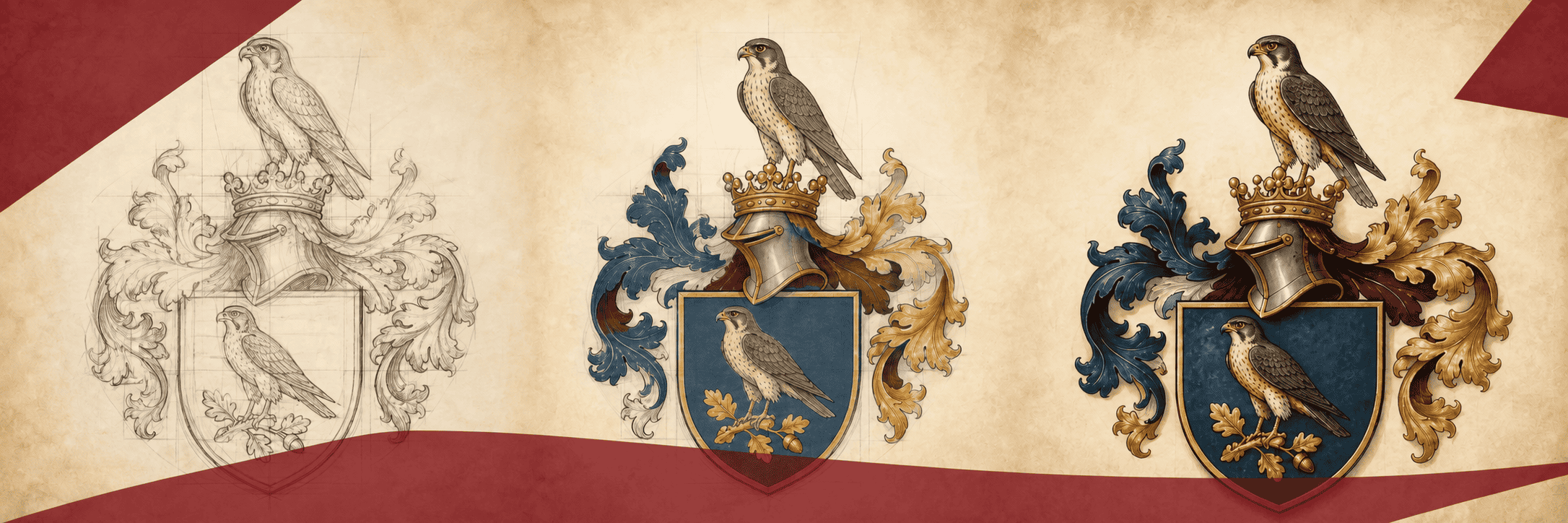
What makes the matter particularly fascinating is that almost none of these titles were invented on the desk to curry favor with anyone. They all originated from real, strenuous tasks, from tangible necessities of defense or the administration of vast territories. Each name originally told the story of a specific duty that a loyal follower took on for his lord long before it Coat of arms became hereditary crowns and precious possessions.
To understand the magic of these titles, one must travel back to their roots: when a title was not just a decorative addition to a passport, but the clear answer to the question of what burden one had to bear within the fabric of the empire. It was a hierarchy that grew over generations, shifted, and eventually created that legendary ranking that stands for brilliance, poise, and timeless elegance to this day.
The Field Commanders and Frontier Guards: How Dukes and Margraves Came Into Being
At the top of the secular order of nobility stood, directly under the kings and emperors, the duke. The linguistic roots of this rank already betray its true origin: A duke was literally the one who marched before the army. In the times of Germanic migrations and Frankish imperial expansions, the monarchs needed experienced military leaders who, in the event of an emergency, led entire tribes like the Bavarians, Saxons, or Swabians into battle. A duke united the military leadership over vast territories and possessed such great prestige that he could almost stand on equal footing with the monarch.
With the transition to a permanent feudal system, this purely warlike command post transformed into an hereditary territorial dominion. The former tribal princes became powerful rulers who ruled in their own lands like little kings. They built residence castles, appointed their own officials, and had finances that often rivaled those of the Crown. Whoever held the ducal crown was undeniably part of the high nobility and determined the fate of the entire empire with decisive voice.
At a similar, often even more fraught strategic level, the Margrave stood. The word "mark" in early medieval times referred to the uncertain, dangerous border regions of the empire, where hostile attacks could be expected at any time. A typical administrative official would simply have been overwhelmed there. Therefore, the rulers granted the administrators of these zones extraordinary powers, the right to build fortified castles, and command over permanent military units, without having to ask for permission beforehand from the distant court.
Because of this enormous military responsibility and the constant risk, the Margrave ranked far above a normal count and was practically equal in status to the duke. The families that successfully defended such a Margraviate for generations rose to become the most influential dynasties in Europe. From rough border posts emerged glorious principalities whose resounding names would dominate history for centuries.
The Heart of the Empire: Counts and the Birth of the Baron
While counts and margraves commanded vast armies and secured the borders of the empire, the heart of day-to-day administration lay at a deeper level. Here, the count ruled, whose title was rooted in a long tradition that reached back to the predecessors of the Roman and Frankish rulers. The count was originally the highest authority for justice and order in a precisely defined administrative region, the Gau. He convened the courts, collected the necessary taxes for the crown, and ensured that the will of the king was heard even in the remotest corners of the empire.
With the growth of these responsibilities, the counts developed into proud rulers of the land with their own castles, extensive landholdings and powerful entourages. They formed the stable backbone of medieval society. The title of count was the epitome of solid power and noble endurance, highly respected in the court and equally feared by the common people who worked on his lands.
Below the counts, a title established that still exudes a very special charm: the Baron, known in the Romance language as the Baron. The term Baron originally meant nothing more than a free lord who held his property free of foreign overlordship and was only directly accountable to the highest sovereign of the land or even the King. A Baron was the lord of his own castle, ruling and controlling his forests and villages and enjoying a high degree of independence.
As the imperial chancelleries began to mold these established relationships into fixed ranks in the late Middle Ages, the titles of Baron and Freiherr largely merged. The Baron became the classic representative of the upper landed nobility. He was worldly enough to appreciate the courtly culture, yet humble enough to stand firmly on his own ground with both feet, which gives this rank its distinctive blend of elegance and character strength to this day.
The roots of blood: the feudal lords in a duel with the noble class
In addition to the mere ranking from Baron to Duke, there existed in the aristocratic hierarchy an invisible but deeply rooted dividing line that provided ample fuel for debate in the salons and on the ancestral galleries. It was the question of the origin of the title, the eternal rivalry between the ancient noble class and the emerging bourgeois nobility. For the guardians of the old traditions, it was by no means crucial what was written on paper, but rather how far back one’s own family tree reached in the fog of history.
In the past, noble families were those whose noble lineage could be traced back to the very depths of the High Middle Ages before the year four hundred. These families did not owe their position to a royal decree, but had been sitting on their fortified castles and knightly estates for what felt like forever. Their nobility was considered inherently noble, almost naturally bestowed by countless generations of noble ancestors. They looked down on those who had to work hard to earn their social advancement.
On the other side of the moat stood the nobility. From the late Middle Ages and especially in the Early Modern period, emperors and kings discovered that the elevation to the nobility could be used very effectively as a political and financial tool. Merited generals, wise jurists, wealthy merchants, or influential court officials were elevated to the noble status with a noble letter, an elaborately decorated parchment with wax seal, and a wax seal. For the aspiring bourgeoisie, this noble letter was the eagerly awaited crowning of their own life’s work, which paved the way to the highest circles.
In practice, for centuries, both camps engaged in a subtle duel. The old nobility scoffed at the freshly printed inkpot, which allegedly still smelled of a writing room or trading office, while the new nobility countered with fresh wealth, modern entrepreneurial spirit, and often far more magnificent palaces. Over time, these resentments faded away, as many old houses were happy to renovate their decaying castles through advantageous marriages with the wealthy new nobility. However, the myth of ancient roots remained a fascinating sign of historical depth.
The Crown of the Pyramid: Princes, Kings and the Path to the Throne
At the very top of the hierarchy of titles was a league that stood out clearly from everything that was understood by the term “simple nobility”: the high nobility. Here, it was no longer simply a matter of managing individual forests or wearing a Wappens, but of real sovereignty, of statecraft and the right to direct the destinies of entire nations. The term “prince,” which refers linguistically to the First or Front Rank, encompassed the ruling houses, which were directly accountable to the Holy Roman Empire and thus solely to the Emperor himself.
The circle of the Electorates was particularly outstanding. This select group of religious and secular princes possessed the exclusive privilege of electing the Roman-German King and future Emperor. One vote in this body weighed heavier than the gold of entire trading cities, for the monarchs had to promise the Electorates enormous concessions, privileges, and territories in every election. An Elector stood in power and wealth far surpassing that of any European king and ruled his country like a small-scale absolutist state.
With the princes and emperors, the world of kingdoms and imperial crowns finally opened up. Here, the belief in divine grace and the idea that one’s own rule was directly legitimized by Heaven solidified. Marriage at this level was not a matter of the heart, but the most powerful instrument of continental diplomacy. Through skillful alliances, kingdoms were merged, wars ended, and new great powers were born.
This elite formed an international caste that was closely related across national borders and shared a common French court language. They created the monuments, opera houses, and castle parks that we still visit with admiration today. It was the absolute pinnacle of a centuries-old order that condensed the brilliance, responsibility, and immense wealth into a spectacle of timeless fascination.
Noblesse as a trait: A rank for every character
When we look at the artistic structure of historical titles today, we quickly realize that the old rigidity of hierarchy has given way to a wonderful lightness. Where once rigid protocols regarding seating arrangements and payments dictated the course of events, today a fascinating spectrum of personality profiles opens up. The titles of the past are no longer instruments of feudal subordination; they are timeless metaphors for individual style, attitude, and a very special sense of life.
Each rank brings its own distinctive aura into the present. The Baron still embodies the appealing blend of worldliness, naturalness, and down-to-earth self-confidence. The Count radiates classic tradition, representative dignity, and the serene grandeur of a cultivated culture. Those who feel drawn to the princely or ducal sphere, on the other hand, appreciate the touch of grand stage, leadership, and the courage to set accents that will be remembered.
That is exactly where the true value of this centuries-old tradition lies in the modern world: it allows one to add a refined, storied facet to one’s identity. It’s not about exalting oneself over others; it’s about encountering everyday life with a touch of grandeur, humor, and class.
The order of the crowns has lost its chains but has retained its elegance. It reminds us that history can be viewed not only in museums but also celebrated as a living expression of one's own taste.