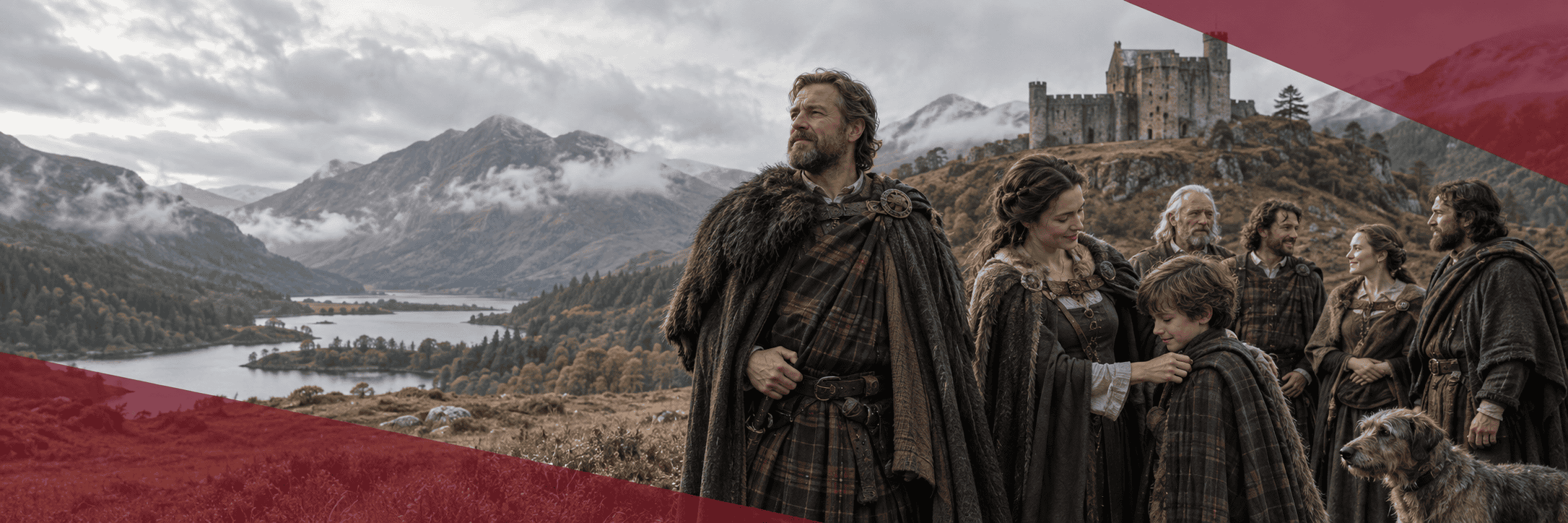

If a Scottish clan chief wanted to call his warriors to arms, he did not send sealed parchments, but the dreaded Crann Tara, The Fiery Cross. Two apple branches were tied together in the shape of a cross, held at the ends in open flames and then extinguished in the fresh blood of a sacrificed goat. Two chosen runners grabbed the smoking wooden sign and sprinted for days through moors, fog-filled valleys and rocky crevices, shouting the clan name and the secret gathering place into the valleys. Anyone of sound mind between the ages of sixteen and sixty who saw the bloody cross had to immediately drop their plough or fishing hook, tighten their broadsword belt and set off. Anyone who ignored the unmistakable marching order or arrived at the meeting point too late was considered a defector who had betrayed the clan; the punishment, according to ancient clan tradition, was that their own hut was burned to the ground in the sight of the clan.
In the rugged highlands, a man was only considered a fully-fledged warrior and eligible for marriage as a noble when he demonstrated his skills in the traditional Cattle raiding The theft of Highland cattle was by no means considered a dirty crime, but rather a highly regarded chivalric sport and the ultimate test of courage for young nobles. The chief’s son led a handful of followers through the territory of an enemy neighboring clan in the protection of moonless nights, slipped past the guards and drove dozens of woolly cattle over treacherous mountain passes back to his own glen. If caught in the act, a bloody chase ensued, with stab wounds serving as honorable trophies. However, if the loot was not discovered unnoticed, the young leader of the entire village community would throw a gigantic barbecue party – and prove to his father that he possessed the qualities to become the new clan leader on horseback.
By the headgear one could already recognize in the Highlands who one was dealing with from a distance, because the feathers on the traditional Balmoral barrette were subject to an iron code of honor. A simple clan member only carried the clan plant – perhaps a heather branch or a thistle – behind the metallic coat-of-arms brooch. Chieftain, The 'sub-leader' who ruled over a particular branch of the family was allowed to adorn himself with exactly two proud feathers. The absolute privilege of wearing three distinctive feathers of the stone eagle on the hat was reserved exclusively for the officially recognized head of the entire genus, the Clan Chief. When two Chiefs met in the Highlands, the bodyguards first controlled the opponent’s feather ornaments to maintain the correct order; anyone who was improperly caught with three feathers provoked a deadly pistol duel immediately, for assaulting the majesty.
After the devastating defeat of the Jacobite clans in the Battle of Culloden in 1746, the British Crown decided to eradicate the military culture of the Highlanders once and for all. With the draconian Act of Proscription In 1747, London banned the wearing of kilts, plaids, and any other tartan patterns throughout the Highlands. Anyone caught wearing their traditional attire was sent to prison for six months for the first offense and, on the second offense, banished to the tropical colonies overseas for seven years as forced laborers. However, the Highlanders did not give up their identity without a fight: To circumvent the law, many men hurriedly sewed their kilts together in the middle so that they could pass off as trousers in front of the English patrols, or secretly wore the banned clan tartan inside their plain wool jackets.
The power of a Scottish chief was not based on anonymous maps, but on a deep belief in common ancestry and the system of kinship. Fosterage. To forge eternal alliances between hostile clans, clan leaders handed over their firstborn sons to friendly families of clan members, where the prince children grew up for years as their own sons. The loyalty between these blood brothers was often many times stronger than that of true blood ties; in battles, the blood brothers formed the unshakable bodyguard of the young chief and rushed into the enemy ranks without hesitation. When the ruler eventually grew old and frail, the clan did not automatically choose the eldest son as the successor, but the most capable warrior from the family, Tanist. A weak, sickly or cowardly heir to the throne was mercilessly ousted by the assembly of the elders of the clan – for in the stormy highlands a clan did not need a tender spirit, but a leader with steel-hard nerves and a sharp blade.