
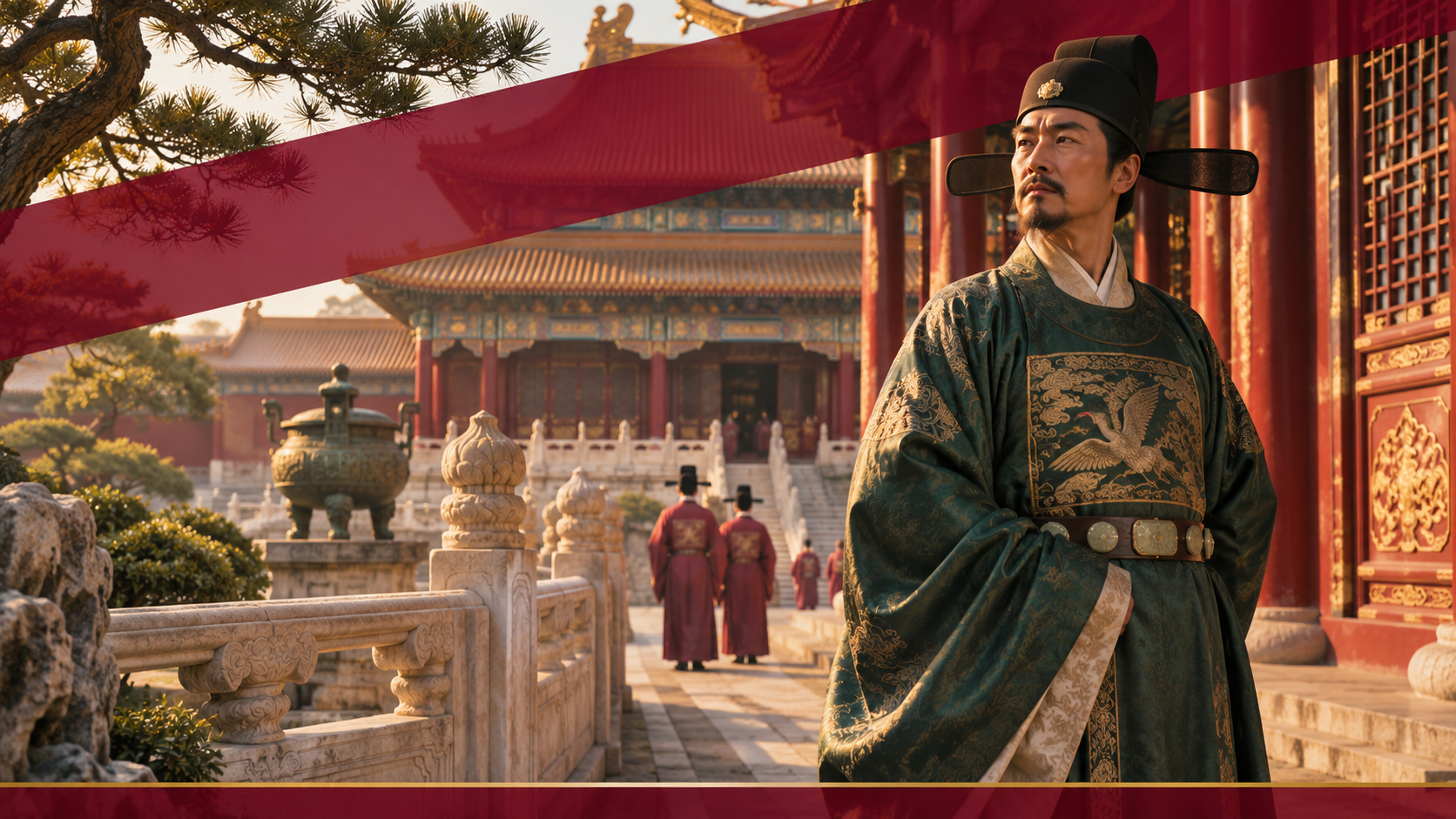
Historical titles in China – rank, ritual, and the heavenly mandate in the Middle Kingdom
Titles in the Middle Kingdom: Order and Philosophy
Over the millennia, Chinese history developed a particularly distinctive language for rank, status, and authority. At its core was the emperor, who was considered the son of heaven and derived his legitimacy from the so-called heavenly mandate. This mandate combined political power with a cosmic order: A just ruler maintained harmony between heaven, earth, and humans. If he lost this ability, his claim to power could be extinguished according to traditional conceptions.
Below the Emperor, a multifaceted structure emerged of families, officials, military leaders, and regional lords. Titles could be tied to ancestry, military merit, administrative duties, or special loyalty. Unlike in many European orders of nobility, the position at court was often closely linked to service to the Emperor. Education, examinations, and administration played as large a role as family and possessions.
The Chinese dynasties created large administrative empires that extended over large parts of East Asia. Qin, Han, Tang, Song, Yuan, Ming, and Qing each developed their own forms of court etiquette. Despite all the differences, one basic idea remained unchanged: rank should make a person’s position within a clearly organized world visible. Clothing, colors, seals, residences, and ceremonial rules could precisely determine who held what rank.
The connection between family and state was particularly important. Great houses could be represented at the court for generations; however, their influence often depended on whether they provided loyal officials, generals, or advisors to the emperor. Therefore, a title was not solely a reminder of ancestry but often also a recognition of specific achievement. A successful field commander could receive a high title, while a meritorious official could rise to the ranks of the court aristocracy.
In addition to the Imperial Court, regional families and rulers held great importance. In times of weakened central power, powerful princes, military leaders, or local dynasties emerged. They controlled cities, trade routes, and fertile lands. Some founded their own empires, while others remained formally connected to the Emperor. The history of China therefore often sees a interplay between a strong central power and powerful regional houses.
Titles also had an important cultural function. They appeared in chronicles, on tomb inscriptions, in poems, and in art. A rank could be determined by the form of an address, the clothing at court, or the position in a procession. Even the architecture of a house and the size of a tomb could be influenced by social rank.
The Chinese title system has a special precision. It ranks people not only according to power but also according to proximity to the emperor, office, merit, and familial status. Terms such as Tianzi, Gong, Hou, Bo, and Zi stand for different levels of this order. Each title carries a unique history and refers to the long tradition of a kingdom that made rank and ritual a central component of its culture.
Tianzi – Son of Heaven
Tianzi literally means „son of heaven“. This designation was one of the highest and most meaningful titles in Chinese history. It described the emperor not merely as a political ruler but as the center of a cosmic order. His task was to maintain harmony between heaven, earth, and humans.
The concept of the Son of Heaven originated in early Chinese state philosophy. The ruler received his legitimacy through the mandate from Heaven. This mandate was not an ownership that belonged forever to a single family. It had to be repeatedly confirmed through just, wise, and successful rule. If an empire experienced famines, rebellions, or great defeats, this could be considered a sign that a dynasty had lost the mandate.
This idea shaped the change of Chinese dynasties. New ruling houses often declared their rise by claiming that heaven had entrusted them with the task of restoring order. The Tianzi stood above all regional rulers and families. He was the highest judge, military leader, guardian of administration, and focal point of the great royal rituals.
At the Kaiserhof, this position was expressed in precise language of colors, ceremonies, and symbols. Yellow was considered the imperial color. The dragon became the most important symbol of power. Audiences, sacrificial ceremonies, and festivals followed a fixed order. Even the number of specific symbols on a garment or the design of a palace gate could make the emperor’s rank visible.
The title of Tianzi combined political power with moral responsibility. An emperor was to protect the country, appoint just officials, promote agriculture, and ensure peace. His rule was measured by whether it brought stability and prosperity. The title was therefore less a mere title than a comprehensive claim to order and leadership.
Until the end of the Empire in 1912, the idea of the Son of Heaven remained a central part of Chinese culture. Palaces, portraits, chronicles, and ceremonial objects preserve the memory of this unique form of rule. Tianzi stands for the pinnacle of a world of titles, where rank, ritual, and cosmic order were inextricably linked.
Gong – Dignity, origin and high status
Gong is often translated as „duke“, but the Chinese title has its own history. It was one of the highest ranks below the emperor and signified special status, closeness to the ruling family, and an outstanding position within the court hierarchy.
As early as the early Zhou period, rank designations were used to organize the relationships between the royal court and important families. A gong could belong to an ancient lineage, possess great merits for the empire, or be entrusted with important duties. The title was therefore closely linked to ancestry, service, and public status.
In many dynasties, gong was awarded to members of the imperial family, successful generals, or particularly meritorious statesmen. It honored an individual and could simultaneously enhance the status of their entire family. The title often included special privileges at court, an emphasized address, and a clear place within the ceremonial order.
However, the rank did not remain the same everywhere. Its meaning changed from dynasty to dynasty. In some eras, gong stood for a powerful regional lord, while in others it was more strongly associated with a high court position. This very flexibility shows how closely title and political order were intertwined in China.
Gong still carries the sound of special dignity. The title evokes the grand courthouses of the Chinese imperial era, the lineages with long traditions, and the importance of loyalty, education, and achievement in the service of the empire.
Hou – Lord of a Borderland
Hou is often translated as „marquis“. In Chinese history, the title had a strong connection to regional responsibility, especially to border areas and important transportation routes. A hou could secure, manage, or militarily protect a strategic landscape on behalf of the ruler.
In early dynasties, the significance of such titles lay primarily in the organization of a large empire. The imperial court could not directly control every remote region. Therefore, it needed loyal families and proven men who assumed responsibility locally. A hou linked the authority of the center to a specific region.
Border areas were particularly significant. There, different cultures, trade routes, and military interests converged. A titleholder had to maintain fortifications, organize taxes, cultivate relationships with neighbors, and, in case of emergency, deploy troops. The rank thus expressed trust and responsibility.
Over time, Hou evolved into an hereditary or honorable title that could be bestowed upon successful generals, officials, or members of important families. The title remained a sign of elevated status and also recalled the ancient duty of representing a landscape in the name of the ruler.
Hou still carries the character of vastness and protection. It refers to the boundaries of a kingdom, to ancient roads, fortresses, and regions that lay far from the imperial capital but were nevertheless firmly integrated into its order.
Bo – Dignity and regional authority
Bo is usually translated as „Graf“ or „Count“. In the classical Chinese ranking system, the title stood below Gong and Hou, but remained associated with high prestige. A Bo could represent an important family, manage an area, or be awarded for special merits at court.
The term appears already in early historical sources and was precisely defined within the old hierarchy. Its meaning, however, depended heavily on the respective dynasty. In some periods, Bo was closely linked to land and regional responsibility, while in others the title was primarily bestowed as an honor at the imperial court.
A title holder could distinguish themselves through military achievements, successful administration, or exceptional loyalty. The Kaiserhof used such dignities to visibly honor deserving individuals and mark their position against other families. The rank thus created order, recognition, and a clear language for merit within the empire.
Bo carries the memory of those families and officials who stood between the imperial elite and the local communities. The title refers to administration, education, and responsibility for a specific area of the empire. Its historical depth lies precisely in this combination of personal achievement and public status.
Zi – Rank, Service and Recognition
Zi is often translated as „viscount“. Within the classical Chinese hierarchy, the title stood below Gong, Hou, and Bo. Its position was lower, but it remained part of a clearly structured world of rank, court ceremonial, and familial prestige.
A title could be awarded for service at the Kaiserhof, military achievements, or successful administration. The title made clear that its holder held a recognized position within the political and social order. It linked personal merit with belonging to a house or lineage.
As with the other Chinese rank designations, the specific meaning changed over the course of the dynasties. At times Zi was more associated with a territory, at other times primarily with honor. What remained crucial was proximity to the imperial order and recognition by the court.
The title reminds us of how finely tuned the Chinese ranking system was. Even at the lowest levels, there was a differentiated system that made performance, loyalty, and background visible.